DTF vs Sublimation: Which Technology Should You Invest In?
DTF vs sublimation is one of the most common technology decisions new print business operators face — and one of the most misunderstood. On the surface, both technologies look similar: both produce vibrant full-color output, both work without minimums, and both are accessible to home-based operators with relatively modest startup budgets. But the similarities end there. Underneath, they work on completely different principles, serve different fabric types, produce different output characteristics, and support different business models. This guide gives you everything you need to make the right investment decision for your specific situation.
How DTF and Sublimation Work — The Core Difference
Before comparing business economics, it helps to understand the fundamental mechanism that makes each technology different — because that mechanism determines everything else.
How Sublimation Works
Sublimation printing uses heat and pressure to convert solid dye particles directly into gas, which then bonds permanently into polyester fabric fibers. The design is first printed onto special sublimation transfer paper using sublimation inks, and then heat-pressed onto the garment. When heat is applied, the dye sublimates — bypassing the liquid state entirely — and the gas penetrates the polyester fibers, becoming physically part of the fabric.
The result is extraordinary: colors that are literally inside the fabric rather than sitting on top of it. There is no layer, no texture, no hand feel impact, and no peeling edge. The decoration is breathable, wash-permanent, and completely integrated into the garment. For the right substrate, sublimation produces some of the most visually stunning output available in the custom decoration industry.
How DTF Works
DTF (Direct-to-Film) prints your design onto a PET transfer film, coats it with hot melt adhesive powder, cures it, and then heat-presses the finished transfer onto the garment. The decoration sits on top of the fabric as a bonded transfer layer rather than inside the fibers.
The critical difference from sublimation is what this means for fabric compatibility — which is the most important practical difference between the two technologies and the one that will shape your business more than any other factor.
Fabric Compatibility: Where the Technologies Diverge Completely
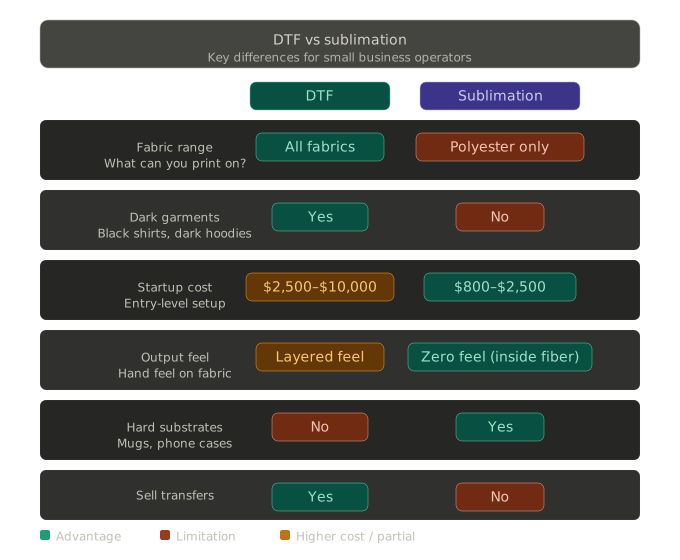
Sublimation has a non-negotiable requirement: the substrate must contain at least 65% polyester, and for best results, 100% polyester. Sublimation dyes bond to polyester fibers. On cotton or low-polyester blends, the dye has nothing to bond to and the output is washed out, faded, and commercially unusable. Light-colored polyester works well. Dark-colored polyester causes dye migration that blends the design with the garment color, making dark fabric sublimation nearly impossible.
This is not a minor limitation — it is a structural constraint on your entire customer base. A customer who wants a custom design on a standard cotton t-shirt, a dark hoodie, a nylon jacket, or a cotton-poly blend simply cannot be served by sublimation. You would have to turn that customer away or refer them elsewhere.
DTF works on virtually any fabric: cotton, polyester, nylon, denim, canvas, leather, spandex blends, and most other materials, in any color. The same heat press settings that work on a white polyester shirt work on a black cotton hoodie. This universal fabric compatibility is DTF’s defining operational advantage and the primary reason many operators who started with sublimation have added DTF or switched to it entirely.
Where Sublimation Has a Real Advantage
Being honest about sublimation’s strengths matters because for operators targeting specific niches, those strengths are decisive.
All-Over Print and Full-Coverage Designs
Sublimation is the only technology that makes edge-to-edge all-over printing economically viable at small scales. Because the dye integrates into the fabric with no visible border, you can print a design that covers the entire garment — front, back, sleeves — without any visible transfer edge. For custom sportswear, performance jerseys, fashion-forward apparel brands, and specialty items like custom socks, tumblers, and phone cases, sublimation’s seamless all-over capability is genuinely unmatched.
Hard Substrate Decoration
Sublimation works on any polyester-coated hard substrate: ceramic mugs, aluminum panels, phone cases, mouse pads, puzzles, license plates, and more. If your business model includes decorated hard goods alongside apparel, sublimation gives you a single ink and printer system that covers both categories. DTF is fabric-only — it has no equivalent hard substrate application (though UV DTF fills part of this gap for flat hard surfaces).
Output Feel on Polyester
On 100% white or light polyester, sublimation output feels like nothing is there at all. The decoration has zero hand feel, zero thickness, and zero edge. For athletic wear, moisture-wicking performance shirts, and any application where the customer values a natural fabric feel, sublimation’s output is genuinely superior to any transfer-based technology including DTF.
Startup Cost Comparison
Sublimation has a lower entry barrier than most custom printing technologies, which makes it appealing to new operators on tight budgets.
A complete entry-level sublimation setup — an A4 or A3 sublimation printer (often a converted Epson EcoTank), sublimation ink, transfer paper, and a heat press — can be assembled for $800 to $2,500. For operators who already own a heat press, the ink and printer alone can be under $500. This low entry point is why sublimation is often the first technology home-based decorators explore.
DTF startup costs are higher. A complete Standard-tier DTF setup runs between $8,000 and $10,000. Even the most budget-conscious DTF entry point using a modified Epson L1800 costs $2,500 to $3,500 once you add the heat press, powder shaker, and initial consumables. See our full DTF startup costs guide for an itemized breakdown.
The startup cost gap is real and meaningful — but it needs to be evaluated alongside the fabric limitation. Sublimation’s low entry cost comes with a narrow addressable market. DTF’s higher entry cost comes with a much broader one.
Revenue Potential: Addressable Market Comparison
This is the business case comparison that most guides skip, and it is arguably the most important factor in the investment decision.
Sublimation operators serve a specific slice of the custom apparel market: customers who want decoration on light-colored polyester garments. That slice is real and profitable — performance wear, sportswear, and decorated hard goods are all strong niches. But it excludes the majority of the everyday custom apparel market, which runs predominantly on cotton and cotton-blend garments in a full range of colors.
DTF operators serve virtually the entire custom apparel market. Cotton t-shirts, dark hoodies, blended polo shirts, denim jackets, nylon tote bags, leather patches — all are accessible with the same equipment and workflow. For operators building a local custom printing business, this breadth translates directly into a larger customer base, fewer turned-away orders, and a business that can grow in more directions.
The numbers reflect this difference in practice. A sublimation business capped at polyester substrates typically needs to specialize deeply (sportswear, promotional products, hard goods) to build sustainable revenue. A DTF business can serve general market demand without specialism and still maintain strong margins across a diverse customer base.
Running Both Technologies: When It Makes Sense
Some operators run sublimation and DTF alongside each other, and the combination can be powerful when the business model supports it.
The combination works well when you serve clients who want both cotton apparel (DTF) and polyester performance wear or decorated hard goods (sublimation). If you are targeting sports teams, for example, you might use DTF for the cotton practice t-shirts and sublimation for the polyester performance jerseys and water bottles. Both technologies share heat press hardware, so the incremental cost of adding sublimation once you have a DTF setup is primarily the sublimation printer and ink — often under $1,500 for an entry-level setup.
The combination makes less sense when you are just starting out. Learning one production technology well before adding a second is a consistent principle among operators who scale successfully. Choose the technology that best fits your primary customer base and add the other when your volume justifies it.
Quick Decision Framework
Rather than declaring one technology universally better, here is a clear framework for choosing based on your actual business situation.
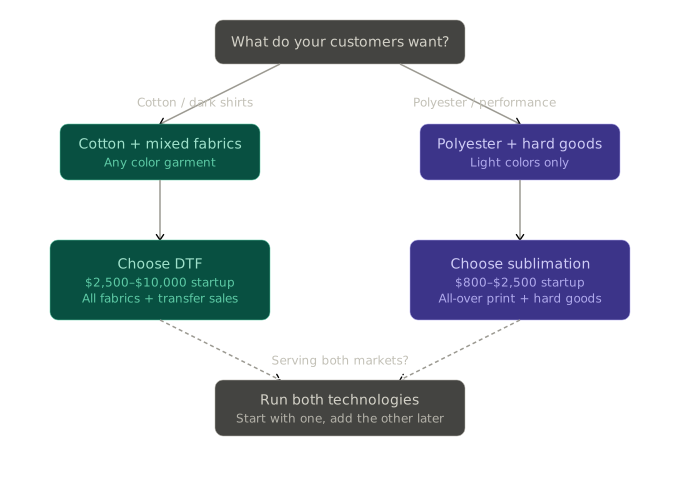
Choose DTF if: Your target customers wear cotton and cotton-blend apparel. You want to serve dark-colored garment orders. You value operational simplicity over substrate specialization. You want the option to sell transfers as a standalone product. You are building a general-purpose local custom printing business.
Choose Sublimation if: Your target market is specifically polyester performance wear, sportswear, or decorated hard goods. All-over print is central to your product offering. You have a very limited startup budget and want to test the market before a larger investment. You are already serving a polyester-dominant niche.
Consider both if: You are targeting sports teams and organizations that need both cotton and polyester decoration. You have established revenue from one technology and want to add complementary capabilities.
| Factor | DTF | Sublimation |
| Fabric range | All fabrics | Polyester / light colors only |
| Startup cost | $2,500–$10,000 | $800–$2,500 |
| All-over print | Limited | Excellent |
| Dark fabrics | Yes | No |
| Hard substrates | No (UV DTF partially) | Yes |
| Sell transfers | Yes | No |
| Best market | General custom apparel | Polyester / performance / promo |
Common Mistakes Operators Make When Choosing Between DTF and Sublimation
Most technology selection mistakes come from evaluating features rather than business models. Here are the mistakes that show up repeatedly when operators reflect on their technology decisions.
Choosing sublimation for its low cost, then discovering the fabric limitation. The most common regret. An operator invests in sublimation, builds a customer base, and then repeatedly loses orders because customers want cotton or dark garments. The cost of missed revenue over six months often far exceeds the price difference between a sublimation and a DTF setup.
Choosing DTF without accounting for the higher learning curve. DTF printhead maintenance, color profile calibration, and powder curing all require hands-on learning time. Sublimation has a much shorter ramp-up period. Operators who underestimate the DTF setup and calibration time often feel frustrated in the first two months before their production becomes consistent.
Assuming sublimation quality on polyester is replicable with DTF. For pure polyester performance wear at high quality, sublimation’s integrated output is genuinely different from a DTF transfer. Operators who switch from sublimation to DTF for polyester applications sometimes find that clients notice the difference in hand feel. Both are commercially acceptable, but they are not identical.
Frequently Asked Questions
Is DTF better than sublimation for a home-based business?
For most home-based businesses targeting the general custom apparel market, yes. DTF works on a much wider range of fabrics and garment colors, which means fewer turned-away orders and a larger addressable customer base. Sublimation is better for home-based operators specifically targeting polyester performance wear, hard goods, or all-over print products.
Can sublimation print on dark shirts?
No. Sublimation dyes are transparent — they mix with the underlying fabric color rather than covering it. On dark or bright-colored polyester, the design colors shift dramatically and become commercially unusable. Sublimation is limited to white and very light-colored polyester substrates for apparel decoration.
How much cheaper is sublimation than DTF to start?
Entry-level sublimation setups can be assembled for $800–$2,500, compared to $2,500–$10,000 for DTF depending on tier. The gap narrows as you move toward professional-grade equipment in both categories. The startup cost advantage of sublimation must be weighed against its narrower fabric compatibility and the business model constraints that come with it.
Can I use a regular heat press for both DTF and sublimation?
Yes. Both technologies use heat press application. Temperature, time, and pressure settings differ between DTF transfers and sublimation paper, but a quality swing-away or clamshell press with accurate digital temperature control handles both workflows. If you plan to run both technologies, a single quality heat press is sufficient.
Does DTF last as long as sublimation on polyester?
On properly cared-for polyester garments, sublimation is generally considered more durable because the dye is physically inside the fabric fibers rather than bonded on top. However, a properly applied DTF transfer on polyester is durable through 40–60+ wash cycles and is commercially acceptable for most applications. The durability difference is most noticeable in high-stress athletic applications where frequent washing and physical abrasion are factors.
Conclusion
Both DTF and sublimation are legitimate, profitable decoration technologies — but they serve different markets and support different business models. Choosing between them is not about which technology is objectively better. It is about which one aligns with your target customers, your available capital, and the business you are trying to build.
At imakedtf.com, we help print shops and home-based operators make smarter technology and marketing decisions from day one. Get in touch →
In the DTF vs sublimation decision, the clearest guidance is this: if your customers wear cotton, DTF is the right investment — and if your customers wear polyester performance gear and you want seamless all-over print, sublimation earns its place.
Related: DTF vs Screen Printing | DTF vs DTG Printing |