DTF vs Screen Printing: Which Is Better for Your Business?
DTF vs screen printing is one of the most important technology decisions a custom apparel business can make in 2026 — and the answer is not as simple as “one is better than the other.” Both technologies are profitable, both produce high-quality output, and both have clear scenarios where they outperform the other. This guide gives you an honest, side-by-side comparison of DTF and screen printing across cost, quality, minimums, turnaround time, and long-term scalability — so you can make the decision that fits your actual business, not someone else’s.
What Is the Core Difference Between DTF and Screen Printing?
Before comparing the two technologies head-to-head, it helps to understand how they fundamentally differ in how they apply color to fabric.
Screen printing is a stencil-based process. Each color in a design requires a separate screen, which is coated with a light-sensitive emulsion, exposed to a design film, and then used to push ink through a mesh onto the garment. The process is fast and cost-efficient at high volumes, but it requires significant setup time and cost for every new design — and adding more colors multiplies that setup cost.
DTF (Direct-to-Film) printing works differently. Your design is printed digitally onto a PET transfer film, coated with hot melt adhesive powder, cured, and then heat-pressed onto the garment. There are no screens to create, no color separation required for the press, and no minimum quantity needed to make a job economical. You can print a single full-color design as cheaply as you can print a hundred.
That fundamental difference — setup cost versus zero setup cost — drives almost every other comparison between the two technologies.
Cost Comparison: DTF vs Screen Printing
Cost is where the conversation usually starts, and it is also where the most confusion lives. The question is not simply “which is cheaper” — it is “which is cheaper at your specific order volume and design complexity.”
Screen printing has significant upfront costs per job. Creating a screen for each color typically costs between $15 and $35 per screen at a commercial shop, or requires your own equipment investment if you are printing in-house. A four-color design requires four screens — so your setup cost alone is $60 to $140 before a single shirt is printed. That cost gets amortized across the print run, which is why screen printing becomes dramatically more cost-effective at higher quantities. At 100+ pieces of the same design, screen printing typically produces the lowest per-unit cost of any decoration method.
DTF has essentially zero per-job setup cost. You pay for film, ink, and powder — materials that cost roughly $1.80 to $3.00 per standard gang sheet regardless of how many colors your design contains. A 50-color photographic image costs the same to print as a single-color logo. This makes DTF uniquely economical for small runs, complex designs, and orders where the customer wants multiple different designs in the same batch.
The crossover point — where screen printing becomes cheaper per unit than DTF — typically occurs somewhere between 24 and 72 pieces for a simple 1-2 color design, and much higher for multi-color or photographic designs. Below that crossover, DTF almost always wins on cost. Above it, screen printing’s per-unit economics become hard to beat.
Print Quality: Where Each Technology Excels
Quality is not a single dimension, and the honest answer is that both technologies produce excellent results — in different ways.
Screen printing produces ink that is physically embedded into the fabric fibers, creating an output that many decorators and customers describe as feeling more “authentic” than heat-applied transfers. For bold, solid colors — team jerseys, brand logos, event shirts — screen printing delivers a vibrant, tactile result that has been the industry standard for decades. Pantone-accurate color matching is also easier with screen printing, which matters for corporate and branded apparel clients who have strict color standards.
DTF produces output that is visually comparable to screen printing for most applications, with some distinct advantages. Full-color photographic images, gradients, fine detail, and designs with many colors all reproduce with accuracy and consistency that would require expensive six-color or eight-color screen printing setups to match. DTF transfers also work on dark fabrics without additional setup — the white under-base is built into the process automatically.
Where DTF falls short compared to premium screen printing is in hand feel and perceived durability on certain high-wear applications. A well-applied DTF transfer is durable through dozens of washes, but premium water-based or discharge screen printing produces a softer, more integrated feel that some customers strongly prefer. For athletic performance wear in particular, screen printing’s breathability advantage over heat-applied transfers is real and worth acknowledging.
Order Minimums and Flexibility
This is where DTF wins decisively for a specific segment of the market.
Screen printing is economically structured around minimums. Most commercial screen printers require a minimum of 12 to 24 pieces per design, and the real economics of the process make orders under 12 pieces genuinely difficult to profit from. Setup costs must be recovered, and at very low quantities there simply are not enough units to spread those costs across.
DTF has no inherent minimum. You can profitably print a single transfer, a single gang sheet, or a single custom order for one customer — and your per-unit economics remain essentially the same whether you print one or one thousand. This is the primary reason DTF has grown so rapidly among home-based operators and small print shops: it unlocks the entire low-volume custom market that screen printing leaves underserved.
For businesses serving youth sports teams, event organizers, small restaurants, or individual consumers who need fewer than 24 pieces with unique designs, DTF is not just competitive with screen printing — it is the only technology that makes those orders economical.
Turnaround Time: A Real-World Comparison
Screen printing turnaround depends heavily on shop capacity and setup complexity. A typical commercial screen print job requires artwork preparation, screen creation, press setup, printing, and curing — a workflow that most shops quote at 5 to 10 business days from artwork approval. Rush orders are available but typically carry a significant premium.
DTF turnaround is significantly faster for most small to medium runs. Once artwork is approved, a home-based or small-shop DTF operator can produce transfers the same day and have them pressed and shipped within 24 to 48 hours. This speed advantage is particularly valuable for event-driven orders — graduations, fundraisers, team tournaments — where the customer often has a hard deadline.
The turnaround advantage diminishes at very high volumes. A screen printing shop running a 500-piece job on a large automatic press will outproduce a single DTF operator significantly. But for the volume ranges most small businesses operate in — under 100 pieces per order — DTF’s turnaround speed is a genuine competitive advantage.
Which Technology Is Right for Your Business?
Rather than declaring one technology the winner, here is a clear framework for deciding which fits your business model.
Choose DTF if: You serve customers who need low-minimum, fast-turnaround custom orders. Your designs are complex, multi-color, or photographic. You are starting a home-based or small-scale operation with limited capital. You want to serve a wide range of fabric types without multiple setups.
Choose Screen Printing if: You consistently fill orders of 48 pieces or more of the same design. Your customers demand specific Pantone color matching or a premium soft-hand feel. You are willing to invest $20,000 to $50,000+ in professional press equipment and supplies. You are targeting corporate, promotional, or branded apparel clients at volume.
Consider running both if: You are building a full-service decoration business targeting both small custom orders and larger volume runs. Many successful print shops run DTF for small-run and complex work while routing high-volume, simple designs to their screen printing press.
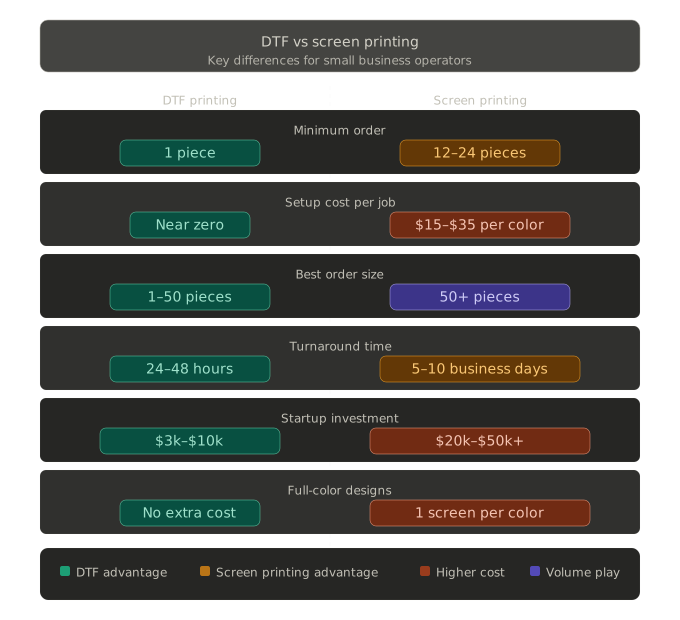
| Factor | DTF | Screen Printing |
| Minimum order | 1 piece | 12–24 pieces typical |
| Setup cost per job | Near zero | $15–$35 per color |
| Best order size | 1–50 pieces | 50+ pieces |
| Full-color designs | Excellent | Expensive (each color = 1 screen) |
| Soft hand feel | Good | Excellent (discharge/water-based) |
| Startup cost | $3,000–$10,000 | $20,000–$50,000+ |
| Turnaround | 24–48 hours | 5–10 business days |
| Fabric compatibility | All fabrics | Flat fabric primarily |
The Business Model Implications
Beyond the technical comparison, DTF and screen printing attract fundamentally different business models — and this is worth considering carefully before choosing your technology.
Screen printing businesses tend to be built around volume accounts: corporate clients, school districts, sports leagues that order the same design repeatedly in large quantities. The economics reward consistency and repeat business at scale. Building a profitable screen printing operation typically requires a sales infrastructure to secure and maintain those accounts.
DTF businesses tend to be built around variety and responsiveness: small businesses, event organizers, individual creators, and online storefronts that need flexible, fast, low-minimum production. The economics reward speed and versatility over volume. A DTF operator can serve dozens of different customers in a single day with completely different orders — something a screen printing operation is structurally not built to do.
Neither model is better — they serve different markets. The question is which market you want to build your business around.
For a complete look at how DTF compares to other printing technologies, see our DTF vs DTG guide.
Frequently Asked Questions
Is DTF printing better than screen printing for small orders?
Yes, for most small orders under 24 pieces. DTF has no per-color setup cost, no minimum quantity requirement, and can be produced and shipped within 24 hours. Screen printing’s per-job setup costs make it uneconomical for small runs unless the same design will be reprinted repeatedly.
Which lasts longer — DTF transfers or screen printing?
Both are durable when applied correctly and cared for properly. Premium screen printing using plastisol or water-based inks on cotton typically produces a slightly more integrated, wash-resistant result on high-wear applications. DTF transfers applied at the correct temperature and pressure are durable through 50+ wash cycles and perform comparably to screen printing for most everyday use cases.
Can I offer both DTF and screen printing in my business?
Yes, and many successful decoration businesses do. DTF handles small runs, complex designs, and rush orders efficiently. Screen printing handles large volume runs of simple designs at a lower per-unit cost. Running both technologies allows you to serve a broader range of customers without turning away business.
Is DTF cheaper than screen printing?
It depends on order size and design complexity. For orders under 24 pieces or designs with more than 4 colors, DTF is almost always cheaper. For orders of 72 pieces or more with simple 1-3 color designs, screen printing typically produces a lower per-unit cost. The crossover point varies based on your specific setup and pricing.
Can DTF printing replace screen printing entirely?
For many small and home-based operators, yes — DTF covers the vast majority of use cases they encounter. For businesses serving corporate clients at high volume, screen printing’s per-unit economics at scale are difficult to replace. Most industry observers expect DTF to continue capturing market share from screen printing in the small-to-medium volume segment while screen printing remains dominant at high volumes.
Conclusion
DTF and screen printing are not competitors fighting for the same customers — they are complementary technologies that serve different segments of the market with different economic structures. The best technology for your business is the one that matches the orders you actually receive, the customers you want to serve, and the capital you have available to invest.
At imakedtf.com, we help print shops and DTF operators build marketing systems that attract the right customers for their technology and capacity. Get in touch →
In the DTF vs screen printing debate, the winner is always the operator who chooses the right tool for the right job — and builds a business around that clarity.
Related: Best DTF Printers for Small Business| How to Start a DTF Business