DTF vs DTG Printing: Cost, Quality & Business Model Comparison
DTF vs DTG printing is a decision that shapes your entire business model — not just the equipment on your production floor. Both technologies print full-color designs directly onto garments, both work without minimums, and both have carved out profitable niches in the custom apparel market. But underneath those surface similarities, they differ fundamentally in how they work, what they cost to run, which customers they serve best, and how much they demand from the operator. This guide gives you a complete, honest comparison so you can make the decision with full information.
How DTF and DTG Actually Work
Understanding the core mechanism of each technology explains nearly every downstream difference in cost, quality, and business model.
How DTF Works
DTF (Direct-to-Film) printing produces transfers, not finished garments. Your design is printed onto a PET film using CMYK inks plus a dedicated white ink layer. The film is then coated with hot melt adhesive powder and cured in an oven. The finished transfer is a peel-and-press product that can be applied to a garment using a heat press — or sold as a ready-to-press transfer to other decorators.
The key insight is that the DTF printer never touches the garment directly. You print to film, cure, and press separately. This separation is what gives DTF its remarkable versatility: since the garment goes nowhere near the printer, it can be made of any fabric — cotton, polyester, nylon, leather, denim, or blends — and the transfer adheres equally well to all of them.
How DTG Works
DTG (Direct-to-Garment) printing works exactly as the name suggests — the garment goes directly into the printer and ink is applied to the fabric surface the same way a standard inkjet printer applies ink to paper. No transfer film, no heat press for the print itself (though a heat cure step is usually needed). The design is applied in one pass, the garment is cured, and it comes out finished.
DTG’s strength is its output feel. Because the ink is deposited directly into the fabric fibers rather than sitting on top as a transfer layer, a well-executed DTG print on a 100% cotton garment has a softness and integration that DTF transfers typically cannot match. For high-end branded apparel where hand feel matters, this is a genuine advantage.
Startup Cost: DTF vs DTG
This is where the gap between the two technologies is most dramatic — and where DTF’s market growth makes the most sense.
A quality DTG printer capable of producing professional output starts at approximately $15,000 for an entry-level unit and scales to $50,000 or more for commercial-grade machines. The investment does not stop there. DTG requires a pre-treatment system — a separate machine that applies a liquid pre-treatment to the garment before printing to help the ink bond to the fabric. Pre-treatment machines add another $1,500 to $5,000 to your setup cost. Quality heat presses, curing ovens, and the blank garment inventory you need to keep on hand push the total first-year investment for a DTG operation to $25,000–$70,000 in many cases.
DTF startup costs are substantially lower. A complete Standard-tier DTF setup — printer, heat press, powder shaker, RIP software, and initial consumables — runs between $8,000 and $10,000. Even a Professional-tier setup with a commercial dual-head printer stays under $20,000 for most operators. See our full DTF startup costs guide for an itemized breakdown.
The cost difference is not incidental — it reflects a fundamental difference in technology complexity. DTG printers are sophisticated machines with multiple ink systems, pre-treatment requirements, and printhead maintenance demands that make them more expensive to build, buy, and maintain. DTF printers handle less complexity per machine because the transfer and pressing steps are handled separately.
Print Quality: Where Each Technology Wins
Neither technology produces objectively better output across all applications. They each have distinct quality characteristics that make them the right choice for different use cases.
Where DTG Wins on Quality
DTG’s quality advantage is most pronounced on 100% cotton garments with simple, bold designs. The ink integrates into the cotton fibers during curing, producing a print that feels like part of the fabric rather than something applied to it. This soft hand feel is particularly valued for premium t-shirts, high-end branded apparel, and any application where the customer will notice and care about how the decoration feels on the garment.
DTG also handles large coverage areas well. A full-front design covering most of a t-shirt looks natural on DTG because there is no visible edge or transfer boundary — the ink simply fades into the fabric at the edges of the design.
Where DTF Wins on Quality
DTF produces more consistent output across a wider range of conditions. Because the print is made on film in a controlled environment and then transferred to the garment, quality variation from garment to garment is significantly lower than DTG. DTG output varies based on fabric composition, pre-treatment application consistency, garment age, and a range of other factors that are difficult to fully control in a production environment.
For photographic images, full-color gradients, and fine detail work, DTF is generally more reliable. The white under-base layer in DTF is applied automatically and consistently as part of the printing process, while DTG white ink management requires careful calibration and is a frequent source of quality inconsistency for operators who have not fully mastered their workflow.
Fabric Compatibility: The Most Important Practical Difference
Fabric compatibility is where DTF’s operational advantage over DTG is most clear-cut and worth examining carefully before making a technology decision.
DTG is optimized for natural fibers — primarily cotton and high-cotton blends. Polyester fabrics cause significant problems for DTG: the ink does not bond properly to synthetic fibers even with pre-treatment, colors can appear dull or washed out, and dye migration from the garment into the ink can cause significant color shifts on bright colored synthetics. Most DTG operators either avoid polyester entirely or limit their polyester work to light-colored garments where dye migration is less visible.
DTF works on virtually any fabric with no substrate-specific adjustments. Cotton, polyester, nylon, canvas, leather, spandex blends, denim — the transfer adheres consistently across all of them at the same temperature and pressure settings. This substrate versatility is not a minor technical footnote. It determines which customers you can serve, which product categories you can decorate, and ultimately how broadly you can grow your revenue base.
For operators targeting performance wear, athletic apparel, workwear, or the growing market for decorated non-garment items (bags, hats, shoes), DTF’s fabric compatibility is a decisive advantage.
Pre-Treatment: DTG’s Hidden Time and Cost Driver
Pre-treatment is a factor that rarely gets enough attention in DTF vs DTG comparisons, and it is worth examining in detail because it affects daily operations, order turnaround, and ongoing costs in ways that are not obvious from spec sheets.
Every dark or colored garment printed on a DTG machine requires pre-treatment before printing. This involves applying a liquid chemical solution to the print area, spreading it evenly, and curing it so it creates a surface the ink can bond to. The process adds 3–10 minutes per garment to your production time, requires a separate pre-treatment machine or manual application system, and introduces a variable that significantly affects print quality when not done consistently.
Pre-treatment chemicals cost between $0.30 and $1.00 per garment depending on coverage area and concentration. At a production volume of 30 garments per day, that is $9–$30 in daily consumable cost from pre-treatment alone — before you account for ink.
DTF has no equivalent step. You print to film, cure, and press. There is no per-garment chemical application, no separate machine, and no quality variable introduced by inconsistent pre-treatment. For operators who value production efficiency and consistency, this is a meaningful operational difference.
Which Business Model Does Each Technology Support?
Beyond the technical comparison, DTF and DTG attract different business models — and this is the most important factor for long-term business planning.
DTG is most naturally suited to print-on-demand single-garment fulfillment, particularly for operators who want to offer a drop-shipping or e-commerce model where individual finished garments ship directly to end customers. The economics of DTG favor printing directly onto garments the moment an order comes in, then shipping finished products. Many Printful, Printify, and Amazon Merch suppliers operate on this model.
DTF is most naturally suited to transfer production — whether selling gang sheets to other decorators, fulfilling custom orders for local businesses and events, or producing ready-to-press transfers for resale. The separation between printing and pressing also gives DTF operators a unique option that DTG operators cannot offer: selling transfers to customers who press them at home. This opens an entire wholesale and distributor channel that DTG simply cannot access.
For a local home-based operator, DTF’s ability to sell transfers — not just finished garments — is a meaningful revenue channel. A single gang sheet printed for $3.00 in materials and sold for $22–$28 delivers margin that is difficult to match in a per-garment DTG operation where garment cost, pre-treatment, ink consumption, and pressing are all stacked.
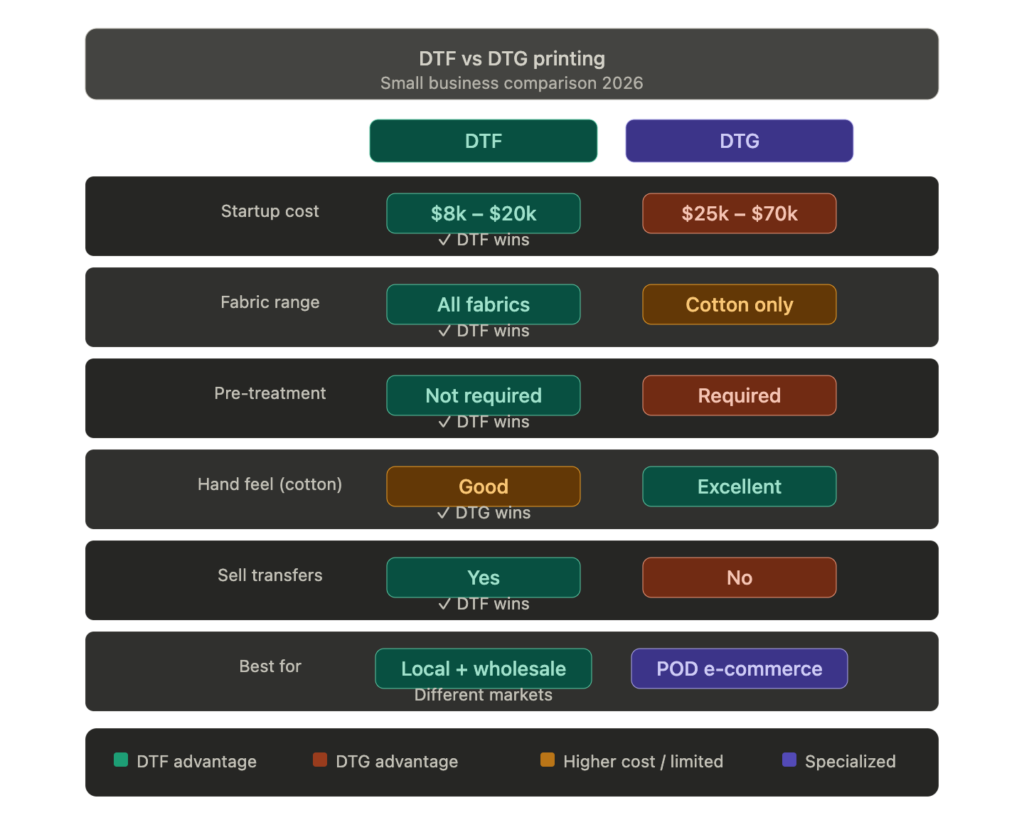
| Factor | DTF | DTG |
| Startup cost | $8,000–$20,000 | $25,000–$70,000 |
| Fabric compatibility | All fabrics | Cotton / high-cotton primarily |
| Pre-treatment required | No | Yes (dark/colored garments) |
| Sells transfers (not garments) | Yes | No |
| Soft hand feel on cotton | Good | Excellent |
| Best business model | Transfer sales, local custom orders | POD, e-commerce fulfillment |
| Maintenance complexity | Medium | High |
The Business Model DTG Operators Rarely Talk About (And DTF Makes Easy)
One of the most underappreciated differences between DTF and DTG is the transfer resale model — and it is worth highlighting because it represents a significant revenue opportunity that most comparison guides ignore entirely.
A DTF operator can produce gang sheets and sell them as products in their own right. The customer takes the transfer home, presses it onto their own garment, and the DTF operator never had to manage blank inventory, garment sizing, or shipping of finished clothing. This model has lower complexity, lower inventory risk, and surprisingly strong margins compared to finished garment production.
DTG operators cannot offer this because DTG prints directly onto garments — there is no intermediate transfer product to sell. A DTG operator’s entire revenue model depends on having the right blank garment on hand, printing on it, and shipping the finished product. This creates inventory complexity that DTF avoids entirely.
For home-based operators who want to keep operations lean and avoid the overhead of blank garment inventory management, DTF’s transfer model is not just an option — it is a strategic advantage.
Frequently Asked Questions
Is DTF better than DTG for small businesses in 2026?
For most small and home-based businesses, yes — DTF offers a lower startup cost, broader fabric compatibility, no pre-treatment requirement, and the ability to sell transfers as a standalone product. DTG makes more sense for operators specifically targeting premium cotton garments for print-on-demand e-commerce, where the soft hand feel justifies the higher investment and complexity.
Can DTF print on the same fabrics as DTG?
DTF can print on more fabric types than DTG. DTG is primarily optimized for 100% cotton and high-cotton blends. DTF works on cotton, polyester, nylon, denim, leather, spandex blends, and most other fabric types without special adjustments or pre-treatment.
Does DTF quality compare to DTG?
For most commercial applications, yes. DTF produces vibrant, durable, full-color output with consistent results across different garment types. DTG has a quality advantage specifically on premium cotton garments where the direct ink application creates a softer hand feel that DTF transfers cannot fully replicate. For photographic images, gradients, and production consistency, DTF is often more reliable than DTG.
How much cheaper is DTF than DTG to start?
DTF startup costs typically run $8,000–$20,000 for a complete professional setup. DTG startup costs typically run $25,000–$70,000 including printer, pre-treatment system, heat press, and initial inventory. The gap narrows slightly if you start with an entry-level DTG printer, but even budget DTG setups cost significantly more than comparable DTF setups.
Can I run both DTF and DTG in the same business?
Yes, and some operators do. DTF handles polyester, small runs, transfer sales, and fast turnaround. DTG handles premium cotton single-garment fulfillment. Running both technologies gives you full market coverage, but also doubles your equipment investment and maintenance overhead. Most operators who run both started with DTF, validated the business model, and added DTG later as a specific product line expansion.
Conclusion
DTF and DTG are not interchangeable technologies that do the same thing at different price points. They are genuinely different tools with different strengths, different business model implications, and different customer bases.
At imakedtf.com, we help operators make smarter technology and marketing decisions — whether you are choosing your first printer or building out a multi-technology operation. Get in touch →
For most small business operators in 2026, DTF vs DTG printing comes down to one question: do you want to sell transfers, serve a wide range of fabrics, and keep startup costs manageable — or do you want to specialize in premium cotton garment fulfillment at a higher investment? The answer to that question points clearly to the right technology.
Last Updated: April 2026 | Related: DTF vs Screen Printing | DTF Startup Costs | Best DTF Printers for Small Business | How to Start a DTF Business |