DTF Printing Startup Costs: Complete Equipment & Budget Breakdown
DTF printing startup costs are one of the most searched — and most misrepresented — topics in the custom apparel industry. Most guides give you a vague range like “$3,000 to $20,000” and move on. This one does not. In this complete breakdown, you will find every cost category itemized across three realistic budget tiers: Starter, Standard, and Professional — along with the hidden costs most beginners discover too late.
What Are the Main DTF Printing Startup Cost Categories?
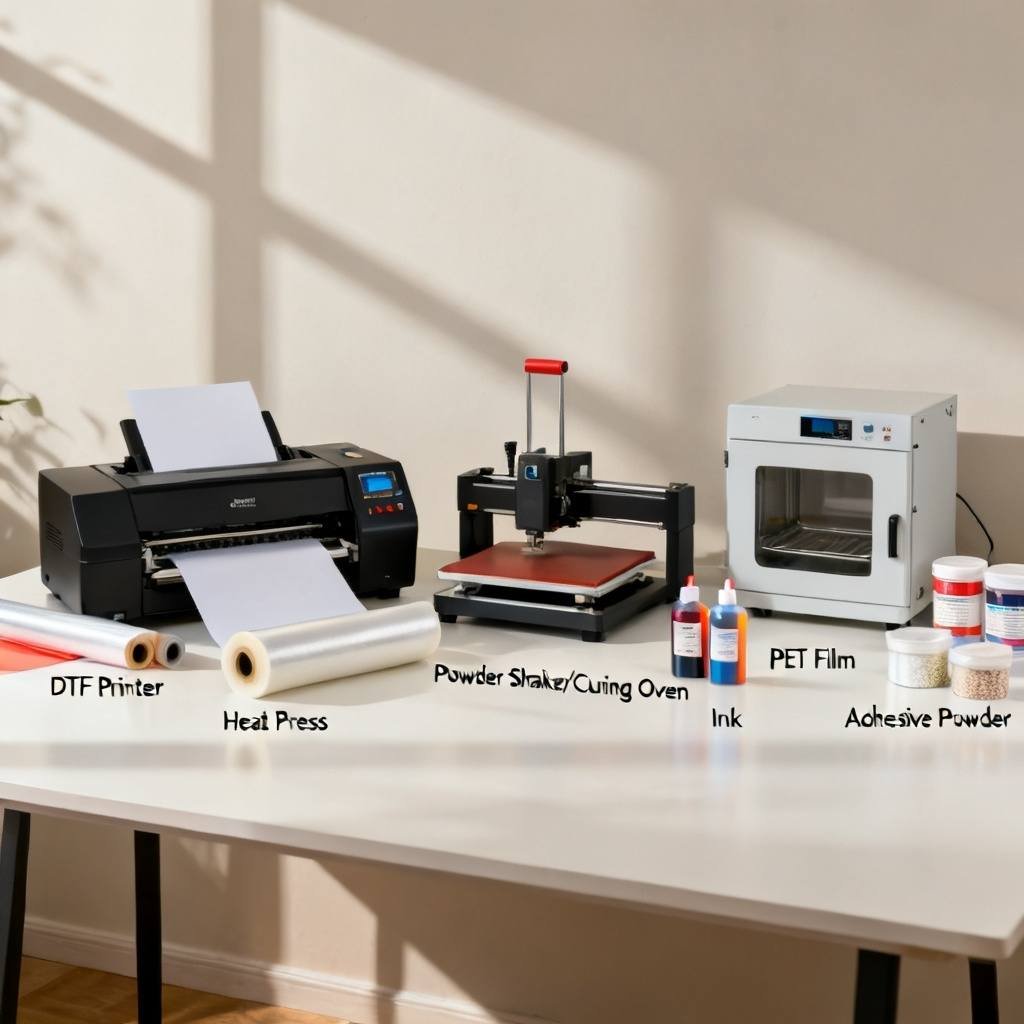
Before diving into the numbers, it helps to understand what you are actually paying for. DTF printing startup costs fall into six distinct categories, each with its own range depending on the scale of your operation.
- Printing hardware — The DTF printer, powder shaker/curing oven, and heat press
- Consumables — Initial supply of ink, PET film, and hot melt adhesive powder
- Software — RIP (raster image processing) software license
- Business setup — LLC registration, EIN, sales tax permit, business bank account
- Digital presence — Website, domain, storefront setup (Etsy, Shopify)
- Marketing — First 90 days of customer acquisition costs
Understanding these six categories prevents the most common budgeting mistake: new operators who only price the printer and ignore everything else consistently run out of money before their first paying customer.
DTF Startup Costs by Budget Tier: Full Itemized Breakdown
The table below reflects realistic 2026 pricing across three common entry scenarios. These are not best-case numbers — they are what most operators actually spend.
| Cost Category | Starter (~$5k) | Standard (~$10k) | Professional (~$25k) |
| DTF Printer | $2,200 | $4,500 | $8,000–$12,000 |
| Heat Press | $400 | $600 | $1,200 |
| Powder Shaker / Curing Oven | $150 | $400 | $900 |
| RIP Software License | $200 | $300 | $500 |
| Initial Ink Supply (all colors + white) | $250 | $450 | $800 |
| Initial PET Film Supply | $100 | $180 | $300 |
| Hot Melt Adhesive Powder | $50 | $70 | $100 |
| Business Setup (LLC, EIN, permits) | $150 | $150 | $200 |
| Website + Domain | $0–$100 | $200 | $500 |
| Etsy / Shopify Storefront Setup | $0 | $100 | $300 |
| Marketing — First 90 Days | $200 | $600 | $1,500 |
| Workspace Setup (shelving, ventilation) | $100 | $250 | $600 |
| Miscellaneous + Emergency Buffer | $300 | $500 | $1,000 |
| Estimated Total | ~$4,100–$5,200 | ~$8,300–$10,300 | ~$15,900–$20,000 |
Prices are based on 2026 US market data. Printer costs assume new equipment purchases; refurbished units can reduce costs by 20–35%.
Starter Tier (~$5,000) — Who It’s For
The Starter tier is best suited for testing the business concept before a larger commitment, or for operators who already own a heat press from previous craft work. The modified Epson L1800 at this price point is capable of producing professional-quality transfers but requires more hands-on maintenance than purpose-built DTF printers. Expect to spend more time on calibration and upkeep.
Best for: Side hustle testing, first-time operators with low risk tolerance, crafters transitioning to a business model.
Standard Tier (~$10,000) — The Most Common Starting Point
The Standard tier is where most serious home-based DTF operators begin. An A3+ format printer from a reputable manufacturer, a quality clamshell heat press, and a semi-automatic powder shaker creates a setup capable of producing 15–25 gang sheets per day with consistent quality. This is the tier where most operators achieve profitability within 4–8 months.
Best for: Home-based operators planning to run DTF as a primary income source within 12 months.
Professional Tier (~$20,000–$25,000) — Built to Scale
The Professional tier is appropriate for operators who have already validated the business model at a smaller scale, have established B2B clients or wholesale accounts, and need production capacity beyond what entry-level equipment can deliver. A dual-head A2 printer dramatically increases throughput and reduces per-sheet production time.
Best for: Operators transitioning from Starter/Standard setup, established decorators adding DTF to their service menu, or those entering with a strong existing client base.
The 6 Hidden Costs Most DTF Beginners Miss
This section covers costs that rarely appear in startup guides but consistently catch new operators off guard. These are not optional costs — they are inevitable, recurring expenses that must be factored into your business model from day one.
1. Printhead Replacement
DTF printheads are consumable parts. Depending on ink quality, maintenance habits, and usage volume, printheads typically need replacement every 6–18 months. Replacement costs range from $150 to $600 depending on your printer model.
Budget: $150–$600 per replacement | Budget one replacement in your first-year projections.
2. White Ink Maintenance Consumption
White DTF ink settles rapidly and requires regular maintenance cycles to prevent clogging. These cycles consume ink even when you are not printing customer orders. On an entry-level printer running 6–8 hours per day, white ink maintenance consumes approximately $50–$100 worth of ink per month.
Budget: $600–$1,200 per year in maintenance ink consumption.
3. Monthly Electricity Costs
Running a DTF printer, curing oven, and heat press for 6–8 hours per day adds meaningfully to your electricity bill. Based on average US commercial electricity rates, expect an increase of $60–$120 per month depending on your setup and local rates.
Budget: $720–$1,440 per year in additional electricity.
4. Film and Consumable Reorder Costs
First-time buyers often underestimate how quickly consumables run out at production volume. A roll of PET transfer film covering 50–100 linear meters costs between $30 and $80 depending on brand and width. At 15–20 gang sheets per day, you will reorder film every 2–4 weeks.
Budget: $100–$200 per month in consumables at moderate production volume.
5. Software Subscription / Renewal Fees
Some RIP software licenses are one-time purchases; others require annual renewal. Kothari Print PRO, for example, has an optional annual support and update subscription. Design software subscriptions (Adobe Creative Cloud, CorelDRAW) add another $30–$80 per month if not already owned.
Budget: $300–$1,000 per year in software costs.
6. Packaging and Shipping Supplies
If you sell gang sheet transfers online through Etsy or Shopify, you will need packaging — flat mailers, tissue paper, branded inserts, and shipping labels. This cost is often ignored entirely in startup budgets.
Budget: $50–$150 per month at early-stage volume.
Total First-Year Cost Reality Check
Most DTF startup cost guides only show you the day-one equipment investment. Here is what your first full year actually costs at the Standard tier:
| Expense | One-Time | Monthly | Annual Total |
| Equipment (Standard tier) | $8,300–$10,300 | — | $8,300–$10,300 |
| Consumables (ink, film, powder) | — | $200–$350 | $2,400–$4,200 |
| Electricity | — | $80–$120 | $960–$1,440 |
| Software (RIP + design) | — | $40–$80 | $480–$960 |
| Marketing | — | $100–$300 | $1,200–$3,600 |
| Packaging + shipping supplies | — | $75–$150 | $900–$1,800 |
| Printhead replacement (projected) | $300–$600 | — | $300–$600 |
| Business + admin costs | $300 | $30–$50 | $660–$900 |
| First Year Total | ~$15,200–$23,800 |
This is a wide range because it depends heavily on your production volume — the more you sell, the higher your consumable costs, but the faster you break even and move into profitability.
DTF Startup Costs vs. Competing Technologies
A common question from entrepreneurs evaluating DTF is how it compares in startup cost to other custom printing technologies. Here is an honest comparison:
| Technology | Entry Cost | Setup Complexity | Substrate Range | Min. Order |
| DTF Printing | $3,000–$20,000 | Medium | Very broad (all fabrics) | 1 piece |
| Screen Printing | $8,000–$30,000 | High | Limited (flat fabric) | 12–24 pieces |
| DTG Printing | $15,000–$50,000 | Medium-High | Cotton/blends only | 1 piece |
| Sublimation | $1,500–$8,000 | Low | Polyester/light fabrics | 1 piece |
| Embroidery | $5,000–$15,000 | Medium | Fabric + structured items | 6–12 pieces |
| UV DTF | $4,000–$25,000 | Medium | Hard surfaces only | 1 piece |
DTF offers the broadest combination of low minimum orders, wide substrate compatibility, and relatively accessible startup costs — which is why it has grown faster than any other custom decoration technology in the past four years.
For a full breakdown of DTF vs. screen printing, see our DTF vs Screen Printing guide.
How to Reduce DTF Startup Costs Without Cutting Quality
Not every dollar of startup cost is fixed. Here are five legitimate ways to reduce your initial investment without compromising output quality or long-term viability.
1. Buy a refurbished or demo printer. Reputable DTF suppliers often sell refurbished units at 20–35% below new pricing. Ensure any refurbished printer comes with a warranty and recent maintenance documentation.
2. Start with a manual powder shaker. A baking rack and a regular oven can replace a $400 powder shaker during the first few weeks of operation. Once you are generating revenue, upgrade to a dedicated unit.
3. Use a free or low-cost RIP trial first. Most professional RIP software offers 15–30 day trials. Use the trial period to calibrate your workflow before committing to a license purchase.
4. Delay the Shopify storefront. An Etsy shop is free to set up and generates revenue from day one. Delay the $200–$500 Shopify investment until your monthly revenue justifies the additional infrastructure.
5. Source consumables from multiple suppliers. Buying ink and film from a single branded supplier is convenient but expensive. Once you understand your printer’s requirements, sourcing compatible consumables from aftermarket suppliers can reduce monthly costs by 30–50%.
DTF Startup Cost FAQs
How much does a DTF printer cost in 2026?
Entry-level modified DTF printers (based on Epson L1800) cost between $1,800 and $2,500. Purpose-built A3+ DTF printers from established brands cost between $3,500 and $6,000. Professional A2 dual-head systems range from $8,000 to $15,000+. Prices have dropped significantly since 2022 due to increased market competition.
Is DTF printing profitable for small businesses?
Yes, when managed correctly. Gross margins on DTF gang sheets typically range from 75–90% on materials. Net margins after labor and overhead average 50–65% for established operators. The business becomes profitable faster at higher volume, which is why niche focus and consistent customer acquisition are the key variables in break-even timing.
What is the cheapest way to start a DTF business?
The lowest realistic starting point is approximately $3,000–$3,500, using a modified Epson L1800 printer, a basic swing-away heat press, and a manual curing method. This setup is functional but slower and more maintenance-intensive than mid-range alternatives. Most operators who start at this level upgrade within 6–12 months.
Do I need a business license to start a DTF printing business?
Most US states require at minimum a sales tax permit and a registered business name (DBA or LLC). An LLC is not legally required but is strongly recommended for liability protection. Costs vary by state — LLC registration fees range from $50 to $500. See our DTF business legal requirements guide for a state-by-state breakdown.
How long until a DTF business breaks even?
At the Standard tier ($8,000–$10,000 startup cost), most operators break even within 4–8 months when generating 10–20 gang sheets of revenue per day. Operators with pre-existing B2B relationships or established Etsy shops often break even faster. Operators building their customer base from scratch typically land in the 6–10 month range.
Conclusion
Understanding your DTF printing startup costs in full — including the hidden, recurring costs most guides skip — is the difference between a business that survives its first year and one that runs out of capital before reaching profitability.
Growing a profitable DTF business takes the right equipment, the right pricing strategy, and the right marketing approach. At imakedtf.com, we help print shops and home-based operators build sustainable, scalable businesses from the ground up. Get in touch →
DTF printing startup costs are manageable at every budget level — but only when you know the real numbers before you spend a dollar.
Related: How to Start a DTF Business from Home |