High Quality DTF Film: The 6 Specs That Actually Determine What You’re Buying
You ran the numbers after Etsy fees, shipping labels, and film costs — and your margin on that last batch of custom tees landed well below where you needed it. Maybe far below. The uncomfortable part isn’t the number itself. It’s that you can’t figure out where the money went, because every roll of film you buy says “premium” on the listing and costs roughly the same per foot. Yet one roll prints clean and peels perfectly, and the next one — from a different supplier, same price tier — bleeds ink, sheds powder in the wrong places, and produces transfers that crack after a single wash cycle. The difference isn’t luck. It’s specification.
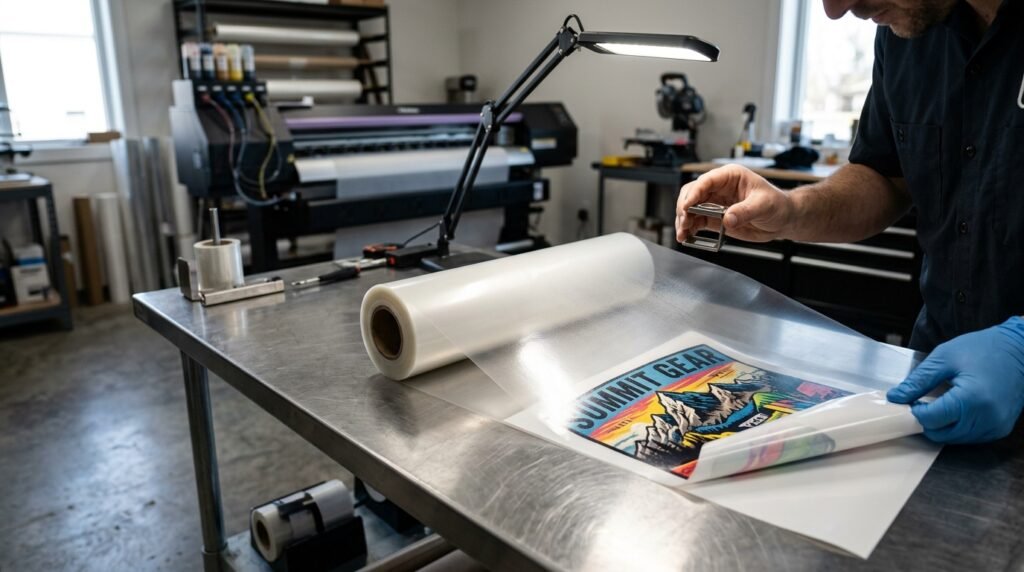
A high quality DTF film is not a brand promise or a marketplace rating. It’s a PET-based carrier film with specialized layers and coatings engineered to accept ink, hold adhesive powder, and release cleanly under heat and pressure [1]. And the gap between a film that works and one that wastes your money reduces to six measurable properties that most resellers never check before clicking “Add to Cart” [2].
Key Takeaways
- Film quality is defined by six specs — thickness, coating uniformity, PET grade, peel classification, powder retention, and shelf life — not by price or brand name [2].
- 75 µm film delivers a softer hand feel suitable for everyday tee printing, while 100 µm handles heavier ink loads for maximum wash resistance [3].
- Peel type (hot, warm, or cold) must match your workflow — cold peel requires at least 30 seconds of cooling before release [2].
- Powder retention quality directly impacts durability — uneven adhesive causes premature peeling during laundering [4].
- Wash-durability claims of 50–100 cycles are vendor-reported, not independently verified across brands, so in-house testing before bulk purchase is essential [1].
- Film degrades in storage — best results come within 6 months to 1 year, even if stock remains technically usable longer [5].
- Knowing these specs lets you calculate true unit cost and stop absorbing hidden waste that erodes your target 30–50% margin.
Why “High Quality DTF Film” Is a Spec Sheet, Not a Brand Name
The phrase “high quality” means nothing until you can measure it against specific film properties. Every supplier uses the term. None of them define it the same way.
What actually separates a reliable film from a problematic one? A short list of testable characteristics: thickness, release and peel behavior, the ink-receptive coating, static control, powder adhesion, and storage stability [2]. DTF film is a PET-based carrier with specialized layers designed to work together under heat and pressure [1]. When any one of those layers is off-spec — coating too thin, static charge too high, release layer inconsistent — the entire transfer fails. And that failure shows up as wasted film, wasted ink, and a customer complaint that costs you far more than the roll did.
For Etsy and Shopify resellers operating on tight margins, the practical consequence is this: buying film without checking specs is the single fastest way to erode profitability you can’t see in your platform dashboard. The waste doesn’t show up as a line item. It hides inside reprints, returns, and the time you spend troubleshooting a press that was working fine yesterday.
Spec 1 — Thickness: 75 µm vs. 100 µm and What Each Costs You Per Transfer
The two standard thickness options — 75 µm and 100 µm — aren’t “good” and “better.” They’re different tools for different jobs, and choosing wrong inflates your cost per design.
Suppliers commonly stock two thicknesses: 75 µm, often described as the standard, and 100 µm as the heavier option [3]. The difference matters more than most resellers realize, because thickness affects hand feel, ink capacity, and material cost per square foot — all of which feed directly into your unit economics.
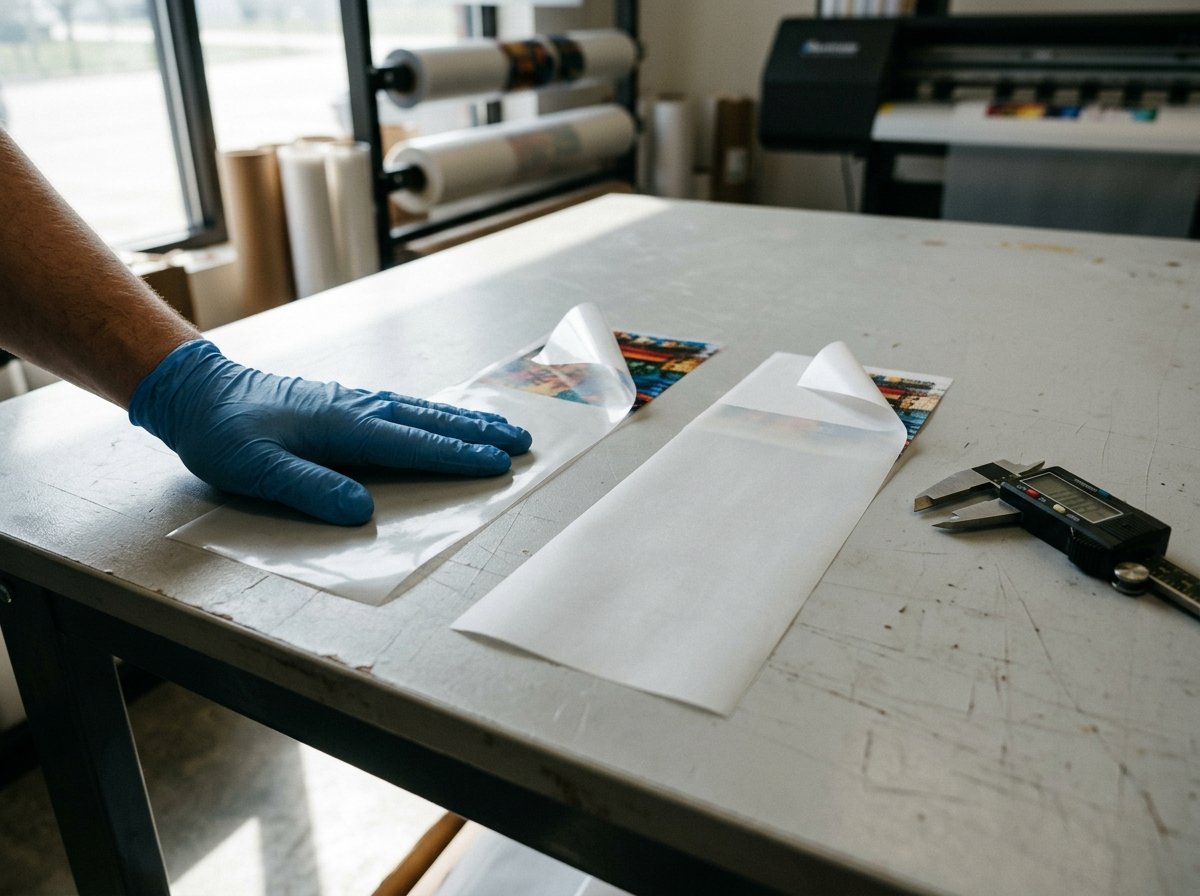
A 75 µm film is generally associated with a softer hand feel and easier handling for everyday T-shirt printing [3]. If you’re selling standard custom tees on Etsy — names, quotes, small graphics on cotton blends — this is likely your workhorse. The thinner film costs less per roll, feeds more smoothly through most desktop and mid-format printers, and produces transfers that feel less plasticky on the finished garment.
The 100 µm option supports heavier ink loads and is preferred when maximum wash resistance or a more robust transfer is needed [3]. Think performance wear, workwear, or any order where the customer explicitly expects durability over softness. The tradeoff is real: thicker film uses more material per sheet, costs more per foot, and can feel stiffer on lightweight fabrics.
Here’s where resellers get tripped up. A common misconception is that 100 µm film is automatically better [1]. It isn’t. It’s a tradeoff. If you’re gang-sheeting six designs onto a single sheet for standard cotton tees, using 100 µm film when 75 µm would perform identically means you’re overspending on every sheet — and that overspend multiplies across hundreds of transfers per month. For a reseller trying to keep cost per design as low as possible, the thickness choice is a margin lever, not a quality badge.
The position worth taking: default to 75 µm for general apparel, and reserve 100 µm stock for orders where the customer is paying a premium for durability. Track which thickness you use per order in your cost calculator, because averaging the two together hides real cost differences.
Spec 2 — Coating Uniformity: Why the Same File Prints Differently on Two Rolls
Coating uniformity determines whether ink absorbs evenly across the film surface — and inconsistent coating is the most common reason identical print files produce different results on different rolls.
The ink-receptive coating on DTF film isn’t just a surface treatment. It’s the layer that controls how much ink the film absorbs, how sharply fine details render, and whether the white underbase stays where it belongs. A quality film should support fine line printing without smudging, which is a practical proxy for coating consistency and ink control [1]. When the coating is uneven — thicker in some areas, thinner in others — you get visible differences in color density across a single print, bleeding on detailed text, and white ink that pools or migrates.
A critical detail that gets overlooked: the coating must match the ink system you’re using [3]. A film optimized for one ink chemistry may underperform with another, reducing ink absorption and causing fading. This is why a roll that worked perfectly with your previous ink supplier might suddenly produce washed-out prints when you switch to a cheaper ink — or vice versa.
For resellers buying film from marketplace sellers or overseas suppliers, coating quality is almost impossible to judge from a product listing. The only reliable approach is to test a small quantity before committing to bulk. Print a standard test file — something with fine lines, gradient fills, and solid color blocks — on every new roll or new supplier’s product. If fine text smudges or gradients band unevenly, the coating is telling you something the listing didn’t.
The white-ink underbase test is especially revealing. A key performance indicator for quality DTF film is the ability to hold a substantial white-ink underbase without runoff, so colors stay vibrant on both dark and light fabrics [2]. If white ink runs or feathers on your test print, that roll will produce transfers that look faded on dark garments — and those are exactly the orders that generate complaints and returns.
Spec 3 — Peel Classification: Hot, Warm, and Cold Aren’t Preferences — They’re Process Parameters
Peel type is a specification of the film, not a personal preference. Using the wrong peel timing for your film causes incomplete transfers, ghosting, and wasted material.
DTF peel timing falls into three categories: hot peel, warm peel, and cold peel, with cold peel often requiring at least 30 seconds before peeling [2]. Each peel type corresponds to a specific temperature window during which the release layer is designed to separate cleanly from the transfer.
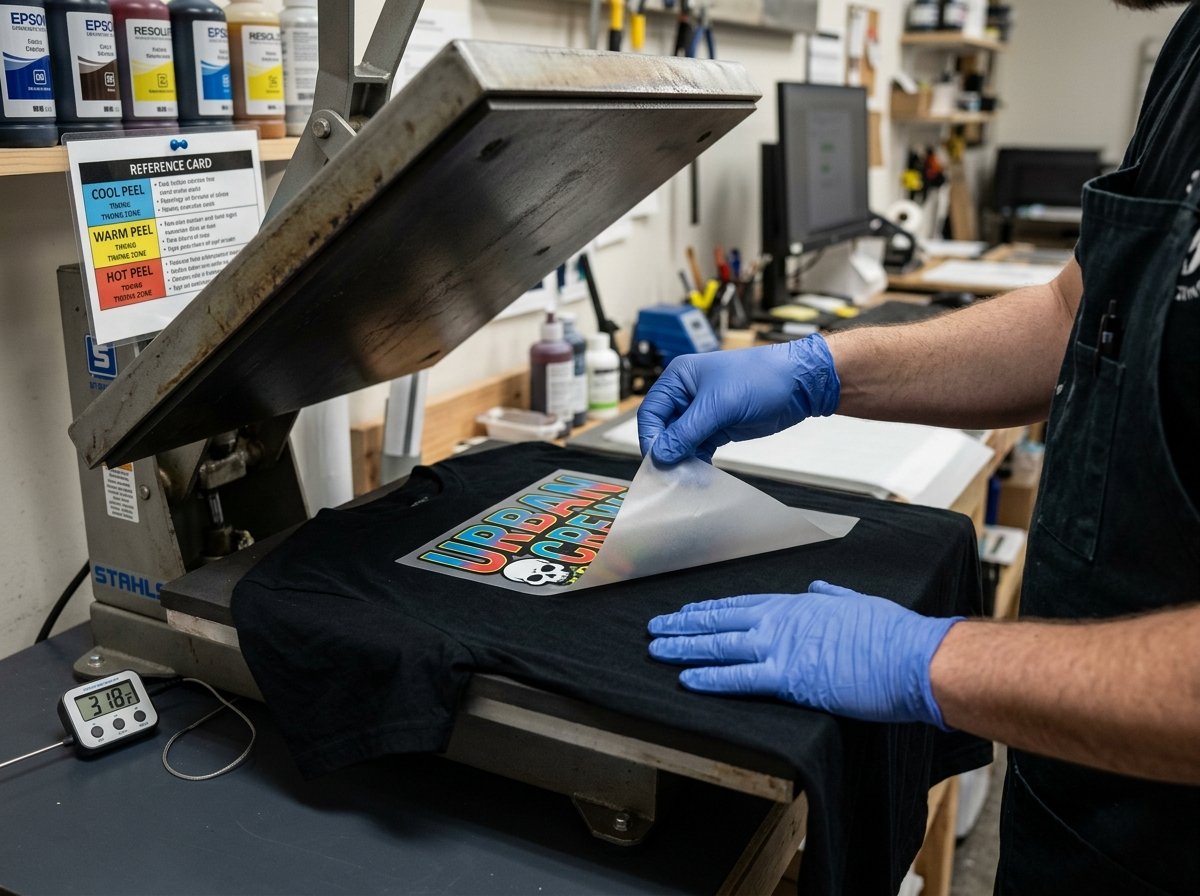
A stable, uniform release layer is what enables a smooth peel with little or no residue during transfer release [1]. When you peel at the wrong temperature for your film’s classification, the release layer hasn’t fully activated (or has already re-bonded), and you get partial transfers, ink left on the film, or a rough texture on the garment surface.
Why does this matter for your margins? Because peel failures are binary. A bad peel doesn’t produce a “slightly worse” transfer. It produces a ruined transfer and a ruined garment. If you’re pressing a $12 blank with a custom design, one peel failure wipes out the profit from two or three successful transfers.
The practical problem for resellers is that not all suppliers clearly label their film’s peel classification. Some films are marketed as “universal” or “multi-peel,” which usually means warm peel but may behave differently at the edges of the temperature range. Before pressing a full order on any new film, test all three peel timings on scrap fabric. Document which timing produces the cleanest release with the least residue. Then standardize your press settings for that film and don’t deviate.
One more thing worth noting: ambient shop temperature and humidity affect peel behavior. A film that peels cleanly as a warm peel in a climate-controlled shop may behave like a cold-peel film in a garage workspace during winter. If your workspace conditions change seasonally, your peel timing may need to shift with them.
Spec 4 — Powder Retention: The Spec That Predicts Wash Durability
Powder adhesion uniformity is a direct predictor of how long your transfers survive laundering — and it’s the spec most resellers never think to evaluate.
After printing, DTF transfers are dusted with TPU (thermoplastic polyurethane) powder, which melts during pressing to form the adhesive bond between the ink and the fabric. The film’s surface properties determine how evenly that powder adheres to printed areas and how cleanly it shakes off unprinted areas. Suppliers commonly describe clean powder shake-off as a quality indicator because excess powder on unprinted areas creates rough edges and lowers finish quality [1].
Powder adhesion uniformity on the film is a key factor in durability, because uneven adhesive leads directly to premature peeling during repeated laundering [4]. This is the mechanism behind the most common customer complaint resellers face: “It started peeling after the first wash.” The ink looked fine. The colors were vibrant. But the powder didn’t bond uniformly, so the transfer delaminates at the weak spots.
Supplier guidance suggests that good DTF films, paired with proper inks and powders, can manage 50 or more wash cycles without significant fading or cracking [3]. High-purity TPU powder can survive 50+ wash cycles when properly melted, and advertised wash ratings are often 50–100 washes [5]. That’s a wide range, though, and the sources presenting it are mostly vendor guidance rather than third-party standardized testing [1].
Anti-static properties play a supporting role here. Supplier guidance explicitly recommends checking for anti-static and anti-blocking properties because those features help reduce printing faults [2]. Static charge causes powder to cling to unprinted areas, producing halos and rough edges around designs. If you’re noticing powder sticking where it shouldn’t — especially in dry winter conditions — the film may lack adequate anti-static treatment.
The honest assessment: wash-durability numbers from suppliers are useful as relative benchmarks, not absolute guarantees. One guide recommends an in-house validation test that includes 50 wash cycles, stretching, and grading for color vibrancy, wash fastness, and hand feel before making large purchase commitments [2]. That level of testing may sound excessive for a small Etsy shop, but even running a dozen or so wash cycles on a test garment before committing to a new film supplier will save you from shipping transfers that fail in the customer’s laundry.
Spec 5 — PET Base Grade: The Invisible Variable
The PET (polyethylene terephthalate) base is the structural backbone of every DTF film, and variations in PET grade affect flatness, curl, and how the film feeds through your printer.
Not all PET is created equal. The base material determines dimensional stability — whether the film stays flat on the platen or curls at the edges during printing. It affects how the film responds to heat during curing and pressing. And it influences whether the film feeds smoothly through your printer’s transport mechanism or jams, skews, and wastes sheets.
For resellers using desktop-format printers (modified Epson units, for example), feed reliability is a daily operational concern. A film that curls or sticks to itself in the sheet feeder creates jams that waste not just the film but also the ink already loaded in the print head’s buffer. Those micro-wastes add up — especially when you’re running gang sheets packed with multiple customer designs where a single jam ruins several orders at once.
PET grade is difficult to evaluate from a product listing. What you can do: pay attention to how the film behaves mechanically. Does it lie flat when you set a sheet on a table, or does it curl toward the coated side? Does it feed without skewing? Does it resist blocking (sheets sticking together in the stack)? Anti-blocking properties are specifically called out in supplier guidance as a feature that reduces printing faults [2].
DTF film is not reusable — the coating is depleted after the initial print-and-transfer cycle [1]. That means every sheet that jams, misfires, or curls during printing is a total loss. The PET base grade is the spec that determines how often those losses happen.
Spec 6 — Shelf Life and Storage: Your Film Is Degrading Right Now
DTF film has a finite shelf life, and improper storage accelerates coating degradation — turning a “great deal” on bulk film into expensive waste.
Storage advice from suppliers is to keep film in a cool, dry place, with one guide specifying around 10–30°C and 40–60% relative humidity [5]. That’s a narrower range than most home-based or garage-based resellers maintain, especially in summer or in humid climates.
One supplier recommends using film within 6 months to 1 year for best results, even though some stock may remain usable for 2+ years [5]. The implication for purchasing strategy is significant. Buying six months’ worth of film at a bulk discount makes sense. Buying two years’ worth does not — even if the per-foot price is attractive — because the coating quality degrades over time, and you’ll start seeing inconsistent prints long before the film is technically unusable.
This is where unit-cost calculation becomes critical. If you buy 100 meters of film at a discount but end up wasting 20 meters to degradation and another 10 to storage-related defects (blocking, curl from humidity cycling), your effective cost per usable meter is substantially higher than what you paid. A proper cost calculator accounts for expected waste rates, not just the invoice price.
Track your film inventory by purchase date. Use older stock first. And if you’re operating in a space without climate control, consider smaller, more frequent purchases even if the per-unit cost is slightly higher. The math almost always favors less waste over lower sticker price.
Putting Specs Into Your Cost Calculator
Knowing these six specs doesn’t just improve print quality — it gives you the data you need to calculate true unit cost and price your transfers for actual profitability.
Most resellers price by feel: look at what competitors charge, add a small margin, and hope the numbers work after platform fees. The problem is that “feel” doesn’t account for film waste from wrong thickness choices, reprints from coating mismatches, returns from peel failures, or degraded stock from poor storage. All of those costs are real, and they all come out of your margin.
When you know your film’s specs, you can build a cost model that reflects reality:
- Thickness choice determines material cost per sheet. Track 75 µm and 100 µm usage separately.
- Coating quality determines reprint rate. A film with consistent coating might give you a 2% waste rate; a cheap film with variable coating might run 8–10%.
- Peel classification determines press time per transfer. Cold peel adds 30+ seconds per press cycle [2], which matters when you’re pressing 50 transfers in a session.
- Powder retention determines return rate. Transfers that fail in the wash come back as refunds and replacement orders.
- Shelf life determines how much film you can buy at once without waste.
Each of these feeds into your cost per design. And cost per design is the number that determines whether you’re hitting 30–50% margin after Etsy or Shopify fees — or quietly losing money on every order.
The durability claims matter here too. High-quality DTF transfers at 50–100 washes can outperform many lower-end screen-print and vinyl solutions that only achieve 30–40 wash cycles [6]. That’s a real selling point for your listings — but only if you’re actually using film and powder that deliver on those numbers. Making durability claims you can’t back up is a fast path to negative reviews and lost repeat customers.
The Real Cost of Skipping the Spec Sheet
Treating all DTF film as interchangeable is the single most expensive assumption a small reseller can make.
The durability, consistency, and usability of your transfers depend on the combined performance of the film, ink, powder, and peel process rather than any single specification [1]. No one spec makes or breaks a transfer. But ignoring all six — buying whatever’s cheapest or most convenient — guarantees inconsistent results and invisible margin erosion.
Shops adopting DTF have grown rapidly, with adoption increasing substantially between 2023 and 2024 [4]. That growth means more competition on platforms like Etsy and Shopify, tighter margins, and customers who compare quality across sellers. The resellers who will survive that competition are the ones who treat film selection as an engineering decision, not a shopping decision.
Before your next bulk film purchase, request a sample roll. Print your standard test file. Press on your most common fabric. Wash it ten times. Grade the result. If the film passes, buy a three-month supply — not a year’s worth. Repeat the test when you reorder, because suppliers change formulations without notice.
That process takes about two hours and costs the price of a few test sheets. Skipping it costs far more — you just don’t see the invoice.
If you’re ready to stop pricing by feel and start building your transfer costs on actual spec data, try the iMakeDTF cost calculator to model your true unit cost and set prices that protect your margin after every platform fee.
FAQ
Does thicker DTF film always produce more durable transfers?
No. While 100 µm film supports heavier ink loads and is associated with greater wash resistance [3], durability depends on the combined performance of film, ink, powder, and pressing parameters — not thickness alone [1]. A well-made 75 µm film paired with the right ink and properly melted TPU powder can deliver excellent wash durability for standard apparel applications.
How should I store DTF film to maximize its usable life?
Keep film sealed in a cool, dry environment — ideally between 10–30°C and 40–60% relative humidity [5]. Use stock within 6 months to 1 year of purchase for best results [5]. Rotate inventory by purchase date, and avoid buying more than a few months’ supply unless your storage conditions are tightly controlled.
Are the “50–100 wash” durability claims on DTF film listings reliable?
Those numbers are supplier-reported benchmarks, not independently verified standards [1]. They represent what’s achievable under ideal conditions with matched film, ink, and powder. The most reliable way to validate durability for your specific setup is to run your own wash tests — even a dozen or so cycles will reveal whether a film performs as advertised before you commit to a large order [2].
Related reading you might find useful:
- How to Calculate Your True DTF Transfer Cost Per Design
- Gang Sheet Packing Guide: Minimizing Your Cost Per Design
- DTF Heat Press Settings by Fabric Type
- DTF Reseller Pricing Strategy After Platform Fees
- Understanding DTF Powder Types and When to Use Each
Resources: Panthera Prints