DTF Printing Business Models: Custom Orders vs Wholesale vs POD
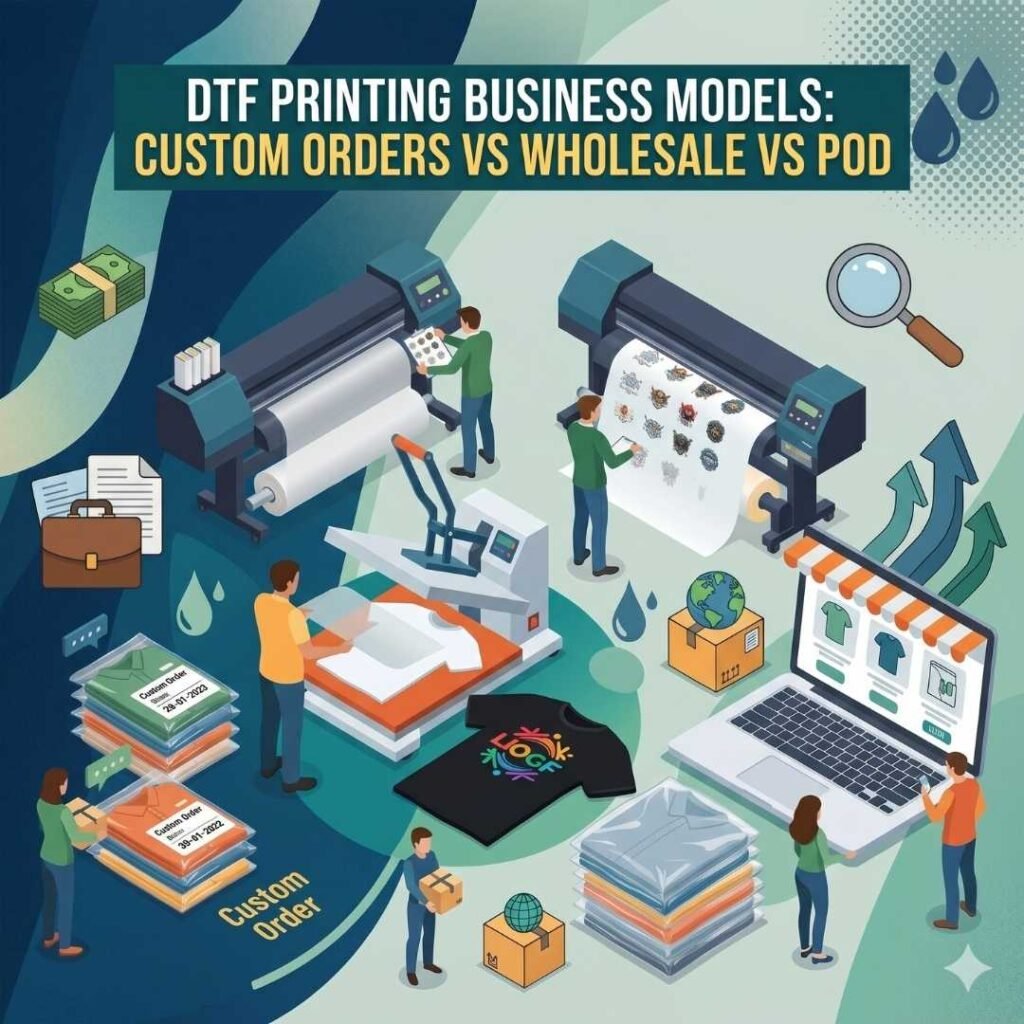
DTF business models are not interchangeable options you pick from a menu — each one pulls your operation in a completely different direction, attracts different customers, and generates revenue in a different rhythm. Most guides list the three models and stop there. This one explains the actual economics of each, which type of operator each model suits, and when it makes sense to combine them or switch.
The Three Core DTF Business Models
Custom Order Model
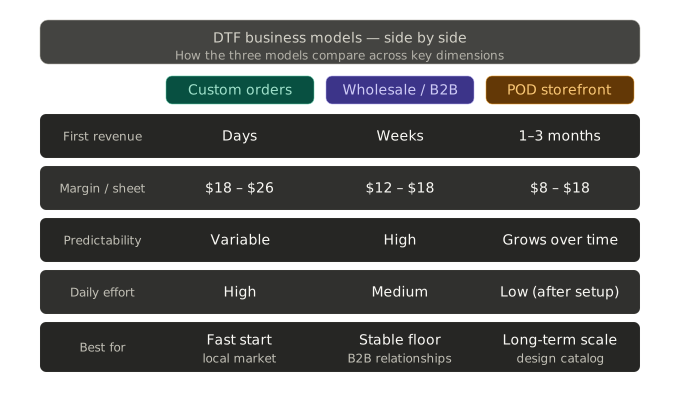
You produce transfers on demand, to customer specification. The customer submits artwork, you print and ship. Every order is unique. Revenue is per-order, turnaround is fast — typically 24 to 48 hours — and there is no inventory to carry.
This is where most DTF operators start, and for good reason. It generates revenue immediately, requires no upfront design investment, and teaches you the production workflow faster than any other approach. The relationship with the customer is direct, and repeat customers are common once trust is established.
The limitation is that revenue is directly tied to your time. Every dollar requires an order, and every order requires production. There is no passive income, no inventory that sells while you sleep, and no leverage unless you raise prices or increase volume.
Wholesale and B2B Model
You supply transfers at volume pricing to other decorators — screen printers, embroiderers, apparel brands, and other print shops — who need DTF capability without the equipment investment. Your customers are businesses, not end consumers.
Margins per sheet are lower than retail. But order sizes are larger, turnaround expectations are more relaxed, and the relationships tend to be recurring. A single wholesale account ordering 100 sheets per week generates more predictable monthly revenue than twenty retail customers ordering sporadically.
The key insight most guides miss: wholesale is not a lower-margin version of retail. It is a fundamentally different business with different cash flow, different relationship management, and a different growth ceiling. A wholesale-focused DTF operation can scale to significant revenue with a small customer list — if those customers are reliable and the pricing is structured correctly from the start.
Print on Demand (POD) Model
You create or source designs and sell ready-to-press transfers as products — typically through Etsy, Shopify, or your own storefront. Customers buy specific designs and press them at home or in their own shops. You are selling a design library as much as a printing service.
This model has a different scaling profile than the other two. A popular design sells repeatedly with no additional production work per sale beyond fulfillment. Your design catalog becomes an asset that generates revenue independent of your daily labor.
The tradeoff is that building a profitable POD business takes longer. You need traffic, a catalog of designs with market demand, and a fulfillment system that handles variable order sizes efficiently. The first 90 days of a POD operation almost always underperform relative to what a custom order operation would generate in the same time with the same equipment.
The Real Economics — What Each Model Actually Generates
This is the section most guides skip entirely. Here is what realistic revenue looks like for each model at moderate production volume.
Custom Order Economics
A home-based operator producing 15 gang sheets per day at $24 average per sheet, five days per week:
- Weekly gross revenue: $1,800
- Monthly gross revenue: approximately $7,200
- Materials cost at 15%: approximately $1,080/month
- Net after materials: approximately $6,120/month
That is a strong margin on paper. The reality is that not every day hits 15 sheets, new customers take time to find, and the first three months almost always run at 30-50% of target volume. Realistic first-year monthly net for a well-run custom operation: $2,000–$4,500 after materials, growing as the customer base builds.
Wholesale Economics
The same operator supplying a wholesale account at $16 per sheet, 60 sheets per week:
- Weekly gross revenue: $960
- Monthly gross revenue: approximately $3,840
- Materials cost at 15%: approximately $576/month
- Net after materials: approximately $3,264/month
Lower net than retail on the same volume — but that volume is guaranteed, predictable, and requires zero customer acquisition effort once the account is established. Two or three solid wholesale accounts can fund the fixed costs of an operation while retail orders generate the upside.
POD Economics
A Shopify or Etsy store with 50 active listings, converting at a 3% rate on 2,000 monthly visitors:
- Monthly orders: approximately 60
- Average order value: $18 (2–3 sheets per order)
- Monthly gross revenue: approximately $1,080
- Materials cost at 15%: approximately $162/month
- Net after materials: approximately $918/month
Those numbers look modest — because month three of a POD store usually is modest. The compounding happens when traffic grows. The same store at 8,000 monthly visitors generates approximately $3,700/month net on the same conversion rate and order size, with no additional labor per visit.
Which Model Fits Which Operator
Choosing a DTF business model is not really about which model is objectively better. It is about which one fits your current situation — your time, your skills, your risk tolerance, and your existing relationships.
Custom Orders Work Best When…
You are starting from scratch with no existing customer relationships and need revenue quickly. You are comfortable with direct customer communication and can manage varied artwork requests. You want to learn production workflow without committing to a specific niche. You are in a geographic market with underserved demand for small-run custom decoration.
The fastest path to first revenue is almost always custom orders. A single outreach session to local sports coaches, restaurants, or small businesses can generate paid work within a week.
Wholesale Works Best When…
You already have relationships in the decoration industry — or the sales skills to build them. You prefer predictable revenue over high-margin variability. You are willing to accept lower per-sheet pricing in exchange for volume and reliability. You want to run a leaner operation with fewer customer touchpoints per dollar of revenue.
Wholesale is also the most defensible DTF business model at scale. A retail or POD customer can switch suppliers easily. A wholesale customer who depends on your turnaround and quality for their own production is significantly harder to displace.
POD Works Best When…
You have graphic design skills or access to quality designs. You are willing to invest 3–6 months building a catalog and driving traffic before significant revenue materializes. You want a model that generates income independent of your daily production schedule. You are already on Etsy or Shopify and understand e-commerce basics.
The Mixed Model — What Nobody Writes About
Here is the business strategy that most DTF guides ignore completely: running two or three models simultaneously, with each one serving a different purpose in your revenue structure.
The most common and effective combination among established DTF operators looks like this:
Custom orders cover fixed monthly costs. They require active work but generate reliable income as long as the customer base is maintained. These are your bread-and-butter orders — local businesses, event organizers, sports teams.
Wholesale accounts provide revenue floor. One or two reliable B2B accounts generating $1,500–$3,000/month mean that even a slow retail week does not threaten your cash position. Wholesale accounts require almost no ongoing marketing once established.
POD storefront builds long-term leverage. The Etsy or Shopify store grows slowly but compounds. Three years of consistent catalog building and SEO creates an asset that generates income with minimal active management.
Most operators who reach $10,000+/month in DTF revenue are running all three — not because they planned it that way from the start, but because each model filled a gap the others left open.
When to Add a Second Model
The most common mistake is trying to run two models simultaneously from day one. This splits focus during the period when focus matters most.
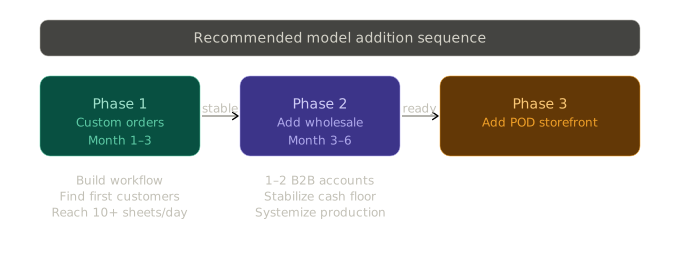
A more effective sequence: spend the first 60–90 days building the custom order operation to consistent profitability. Once you are producing 10–15 sheets per day reliably and your customer acquisition process is working, introduce one wholesale account. Once wholesale is stable, start the POD storefront. Each addition builds on operational stability rather than fighting for attention during the hardest phase.
Pricing Strategy Differs Significantly by Model
One area where model selection creates real operational complexity is pricing. The right price for a custom retail order is not the right price for a wholesale account — and pricing POD products requires a completely different calculation.
Custom Order Pricing
The standard formula: material cost × 6 to 8. A sheet costing $2.50 in materials should retail at $15–$20 minimum, and most operators price standard 22×24 gang sheets at $22–$28. Price below $18 and you are likely working for less than minimum wage once labor is included.
Wholesale Pricing
Wholesale pricing typically runs at material cost × 4 to 5. The reduced margin is acceptable because wholesale removes customer acquisition cost, reduces customer service time, and guarantees volume. Never discount below material cost × 3.5 — below that level, you are subsidizing your customer’s business at a net loss.
POD Pricing
POD pricing depends on your platform, shipping costs, and design uniqueness. On Etsy, gang sheet transfers typically sell at $8–$22 per sheet depending on size and design complexity. The margin calculation must include platform fees (6.5% on Etsy), payment processing (3%), and shipping — which can consume $3–$6 per order depending on destination.
For detailed pricing calculation across all three models, see our DTF startup costs guide which includes a full margin breakdown by model.
Setting Up Your POD Storefront With a Gang Sheet Builder
The operational challenge unique to POD is that customers order individual designs in small quantities. Without a systematic gang sheet layout process, you end up printing nearly empty sheets — wasting film, ink, and powder on a single 4-inch design centered on a 22×24 sheet.
The solution is a gang sheet builder that allows customers to configure their own layout, selecting multiple designs to fill a single sheet. This approach does three things simultaneously: it reduces your material waste per order, it increases average order value as customers add more designs to fill their sheet, and it reduces the back-and-forth communication about what fits where.
Common Mistakes When Choosing a DTF Business Model
Most model selection mistakes share a common root: choosing based on which model sounds most appealing rather than which fits your actual situation.
Choosing POD because passive income sounds appealing, then discovering it is not passive at all for at least 12 months. Building a profitable POD catalog requires consistent design creation, SEO optimization, and traffic building. None of this is passive at the start.
Pursuing wholesale before the custom operation is profitable. Wholesale requires pricing discipline that you can only develop after understanding your true production costs. Operators who go straight to wholesale often underprice and cannot reverse it without losing the account.
Ignoring the mixed model. Running one model exclusively for years when a second model would complement it is a missed opportunity. The combination of stable wholesale revenue and growing POD income is more resilient than either alone.
Not setting up a proper order system before scaling. Each model requires a different intake process. See our legal requirements guide for the order form clauses that protect you as volume grows.
Frequently Asked Questions
Which DTF business model makes the most money?
No single model universally generates the most revenue — it depends on your market, skills, and time horizon. Custom orders generate the fastest early revenue. Wholesale provides the most stable revenue floor at scale. POD has the highest long-term leverage if you build a catalog that generates consistent traffic. Most operators above $8,000/month in revenue are running a combination of at least two models.
Can I start with POD and switch to custom orders later?
Yes, and many operators do the reverse — starting with custom orders to build cash flow and production skills, then adding a POD storefront once the operation is stable. The skills transfer well. Production workflow, color calibration, and gang sheet optimization all apply to both models.
How do I find wholesale DTF customers?
The most effective approach is direct outreach to decorators in adjacent categories — screen printers, embroiderers, and apparel decorators who receive orders for transfers but do not have DTF capability. Trade shows, local decorator associations, and LinkedIn outreach to print shop owners in your region are all productive channels. See our how to start a DTF business from home guide for specific outreach scripts.
What is the best platform for selling DTF transfers as POD?
Etsy is the highest-intent marketplace for ready-to-press transfers and generates the fastest early organic traffic for new shops. Shopify provides better long-term margin and control. Most serious POD operators run both — Etsy for discovery and Shopify for repeat customers and higher-value orders.
Do I need different equipment for different DTF business models?
No. The same printer, heat press, and powder shaker handle all three models. The operational differences are in workflow, pricing, and customer management — not in hardware. The main equipment consideration across models is production capacity: if wholesale orders push your volume above your printer’s daily throughput, an equipment upgrade becomes necessary.
Conclusion
The right DTF business model is not a fixed choice — it is a starting point. Most operators begin with custom orders because that is where first revenue comes from. They add wholesale when stability matters more than margin. They build a POD storefront when they are ready to invest in long-term leverage.
Understanding how each model works, what it actually earns at realistic volume, and when to combine them is what separates operators who plateau at $2,000/month from those who build to $10,000 and beyond.
At imakedtf.com, we help DTF businesses build marketing systems that work across all three models — attracting the right customers at each stage of growth. Get in touch →
DTF business models are not competing options — they are phases of the same business, each adding a layer of revenue stability and scale that the previous one could not provide on its own.
Last Updated: April 2026 | Related: How to Start a DTF Business from Home | DTF Startup Costs | Gang Sheet Builder | DTF Legal Requirements