Legal Requirements for Starting a DTF Business in the US
DTF business legal requirements are more manageable than most people expect — but there are layers that generic small business guides consistently ignore. The basics take a few hours to sort out. The details, particularly around home-based zoning and sales tax collection, take longer and create real problems for operators who skip them. This guide covers everything you need, in the order you actually need it, including several requirements that almost no DTF-specific guide addresses at all.
Step 1: Choose Your Business Structure
Sole Proprietor vs. LLC — What Most Operators Actually Do
A sole proprietorship requires no registration. You are the business, the business is you, and your personal and business finances are legally the same. It is the default structure for anyone who starts selling without forming a formal entity. The problem is that personal liability extends to everything — if a customer sues your business, your personal bank account, your car, and your home equity are all on the table.
An LLC (Limited Liability Company) separates your personal assets from business liability. If someone files a claim against your business, your personal assets are generally protected. For a print shop producing physical products that end up on people’s bodies, that separation is not abstract. It matters.
The cost to form an LLC varies significantly by state. California charges $800 per year just in franchise tax, regardless of revenue. Wyoming charges $60 per year. Most states fall between $50 and $200 for initial filing. The table below shows formation fees for the most common states among DTF operators:
| State | LLC Formation Fee | Annual Fee | Notes |
| Texas | $300 | $0 (no annual report fee) | Popular for home-based ops |
| Florida | $125 | $138.75 | Annual report required |
| California | $70 | $800 minimum | High ongoing cost |
| Wyoming | $102 | $60 | Lowest ongoing cost |
| Delaware | $90 | $300 | Preferred for investors |
| New York | $200 | $9 biennial + publication | Publication requirement adds $300–$1,500 |
Most solo home-based DTF operators choose their home state for simplicity, unless they have specific reasons to form elsewhere.
DBA (Doing Business As) — When You Need One
If you form an LLC called “Smith Transfers LLC” but operate under the brand name “SunState Transfers,” you may need to file a DBA in your state or county. DBA requirements vary:
- Required in most states when operating under a name different from your legal entity name
- Cost: $10–$100 depending on state and county
- Renewal: typically every 1–5 years
- Where to file: usually your county clerk’s office or Secretary of State
A DBA does not create liability protection — it is purely a name registration. You still need the LLC for that.
Step 2: Get Your Federal EIN
An EIN (Employer Identification Number) is your business’s tax identification number, issued free by the IRS in about 10 minutes at irs.gov. You need it to:
- Open a business bank account
- File business taxes
- Hire employees (when the time comes)
- Apply for a sales tax permit in most states
- Work with wholesale suppliers who require business documentation
Even if you have no employees and file taxes as a sole proprietor, getting an EIN is worth doing. It lets you keep your Social Security number off vendor applications and customer-facing documents.
Step 3: Sales Tax Permit and Nexus — The Part Most Guides Skip
What a Sales Tax Permit Is
A sales tax permit (sometimes called a seller’s permit or sales and use tax permit) authorizes you to collect sales tax from customers and remit it to your state. In most states, selling tangible goods — including DTF transfers and decorated garments — requires a sales tax permit. Operating without one exposes you to back taxes, penalties, and interest.
Application is free in most states and takes 5–15 minutes online through your state’s Department of Revenue website.
Sales Tax Nexus — The Requirement Most DTF Guides Ignore Completely
Here is what almost no DTF business guide explains: you may be required to collect and remit sales tax in states where you have never physically set foot, simply because you sell to customers there.
This is called economic nexus. Following the 2018 Supreme Court decision in South Dakota v. Wayfair, states can require out-of-state sellers to collect sales tax once they exceed a threshold — typically $100,000 in sales or 200 transactions in that state per year.
For a home-based DTF operator selling transfers on Etsy or Shopify and shipping nationwide, this matters. Once you cross the threshold in a given state, you are legally required to register in that state and collect their sales tax rate.
Practical guidance for most small DTF operators:
- Under $100,000/year total revenue: Focus on your home state only. Economic nexus thresholds are almost certainly not triggered.
- $100,000–$300,000/year: Begin tracking sales by state. A few high-volume states (California, Texas, New York, Florida) may trigger nexus.
- Over $300,000/year: Consult a sales tax specialist. Platforms like TaxJar ($19–$99/month) automate nexus tracking and filing across states.
Most Etsy sellers benefit from Etsy’s marketplace facilitator status — Etsy collects and remits sales tax on behalf of sellers in most states, which eliminates the compliance burden for most small operators.
Step 4: Resale Certificate — The Tax Savings Most Operators Miss
What It Is and Why It Matters
A resale certificate (also called a reseller’s permit or exemption certificate) lets you purchase supplies — ink, PET film, adhesive powder, blank garments — without paying sales tax, because you will collect tax when you sell the finished product.
This is not a minor detail. At $500–$1,500/month in supplies, sales tax on purchases runs $40–$150/month depending on your state’s rate. That is $480–$1,800 per year you should not be paying.
How to Get One
Your resale certificate comes from the same state agency that issues your sales tax permit — usually your Department of Revenue. In most states, it is the same application or a simple add-on. Present it to your suppliers when ordering ink, film, and other production materials.
Not all suppliers accept resale certificates, and some require a specific format. Keep a copy on file digitally and send it proactively when setting up new supplier accounts.
Step 5: Home Occupation Permit — The Requirement Nobody Mentions
What Residential Zoning Has to Do With Your DTF Business
Most residential properties are zoned for residential use only. Running a commercial operation from your home — including receiving commercial deliveries, operating commercial equipment, and potentially having customers visit — may technically violate your zoning classification.
A home occupation permit is a local government approval that authorizes you to conduct limited business activities from a residential address. Requirements vary significantly by municipality:
- Some cities require a formal permit application, an inspection, and an annual renewal fee ($25–$150)
- Others require only a simple notification filing
- Many suburban and rural municipalities have no formal process and do not enforce residential zoning for home-based businesses unless neighbors complain
Where the problem actually comes up: Insurance claims, LLC registration, business license applications, and B2B client due diligence sometimes require confirmation that your operating address is properly zoned for commercial activity. Discovering a zoning violation during an insurance claim — when a fire or flood is being investigated — is not a good time.
How to Check Your Status
Call your city or county planning department and ask: “I operate a home-based manufacturing business involving a printer and heat press. Do I need a home occupation permit?” Most municipalities will tell you exactly what is required in under five minutes.
If a permit is required, the process is typically simple. You will confirm that you have no employees coming to the property, no customer foot traffic, no exterior signage, and no equipment visible from the street. Most small DTF operations qualify without issue.
Step 6: Business Bank Account and Bookkeeping Setup
Why Mixing Personal and Business Finances Kills Your LLC Protection
Forming an LLC but continuing to run all money through your personal bank account — a practice called “piercing the corporate veil” — can eliminate your liability protection entirely. Courts have repeatedly ruled that when business and personal finances are indistinguishable, the LLC structure does not apply.
Open a separate business checking account before your first paid transaction. Most major banks offer free or low-fee business checking for sole-member LLCs. Online options like Mercury, Relay, or Bluevine work well for home-based operators and have no monthly fees.
Basic Bookkeeping From Day One
You do not need sophisticated accounting software to start, but you do need to track:
- Revenue (every paid order)
- Cost of goods sold (ink, film, powder per order)
- Operating expenses (equipment, software, insurance)
- Tax collected and owed
Wave (free) and QuickBooks Simple Start ($30/month) both handle DTF business bookkeeping adequately. Connect your business bank account so transactions import automatically.
Step 7: Copyright and Intellectual Property — What Your Order Form Needs to Say
The Legal Gap in Almost Every DTF Business
Most DTF operators take orders verbally, by text, or through an informal intake process. Almost none include a written clause that protects them when a customer submits artwork they do not have rights to use.
When a rights holder discovers that their copyrighted or trademarked design was produced by your shop — even if the customer provided the artwork — you can be named in the claim as the manufacturer. “They gave it to me” is a starting point for a defense, not a complete one.
The fix is a written warranty of rights clause in your order form. Here is example language that IP attorneys recommend for print shops:
“Customer represents and warrants that they own or have the legal right to reproduce all artwork, images, text, logos, and other content submitted for production. Customer agrees to indemnify and hold [Business Name] harmless from any claims, losses, or liabilities arising from the reproduction of customer-submitted content.”
This language does not make you immune to claims. It does create a documented basis for shifting liability back to the customer and demonstrates your good faith in the event of a dispute.
Step 8: DTF Ink Shipping Classification — What Operators Who Ship Supplies Miss
Hazmat Considerations for DTF Inks
If you purchase DTF inks in bulk and store them, or if you resell ink to other operators, you need to understand basic shipping classification for these materials.
DTF inks — particularly white ink containing titanium dioxide — may be classified as hazardous materials under DOT (Department of Transportation) regulations for certain shipping methods. Air shipment of DTF inks is subject to IATA dangerous goods regulations. Most ground shipping of small quantities falls under the DOT’s limited quantity exemption.
This matters in two practical scenarios:
- Importing inks from overseas suppliers: Some DTF inks are restricted from air freight and must ship by sea, which affects lead time planning
- Shipping inks to other operators: If you resell bulk ink, mis-shipping classified materials can result in package rejection, fines, and carrier account suspension
For most operators who only buy and use ink for their own production, this is not an active concern. For those who import directly or sell supplies as a secondary business, it is worth a conversation with your freight broker or a logistics company familiar with printing industry materials.
The Complete Legal Checklist for Starting a DTF Business
Here is everything in one place, in order of priority:
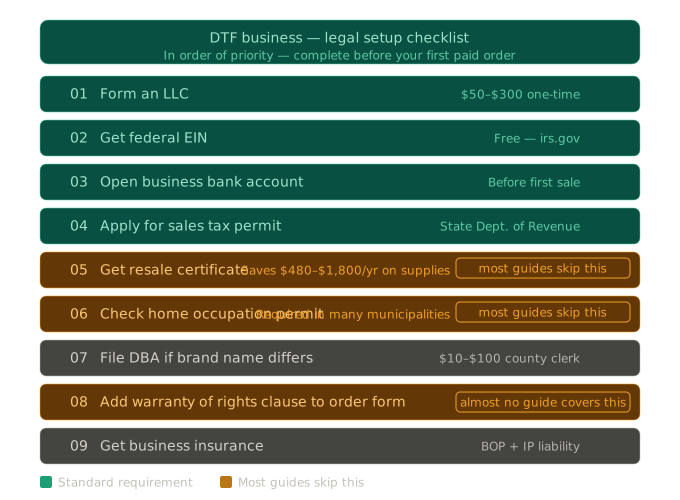
- Choose business structure — LLC recommended for liability protection
- Register your LLC — through your state’s Secretary of State website
- Get your EIN — free at irs.gov, 10 minutes
- Open a business bank account — before your first paid order
- Apply for a sales tax permit — through your state’s Department of Revenue
- Get a resale certificate — from the same agency, same application
- Check home occupation permit requirements — call your city or county planning department
- File a DBA if needed — if your brand name differs from your legal entity name
- Add warranty of rights clause — to your order form, Etsy policies, and checkout terms
- Get business insurance — see our DTF business insurance guide for full coverage recommendations
- Monitor sales tax nexus — as your revenue grows beyond your home state
For a full breakdown of startup costs including legal fees, see our DTF startup costs guide.
Frequently Asked Questions
Do I need an LLC to start a DTF business?
No — you can operate as a sole proprietor without any formal registration in most states. However, an LLC provides liability protection that is genuinely meaningful for a business producing physical products. The filing cost is $50–$300 in most states, and the protection it provides is worth far more than that in any scenario where a customer files a claim.
Do I need a business license for a DTF printing business?
“Business license” means different things in different places. At the state level, a sales tax permit is usually the primary licensing requirement. At the local level, some cities and counties require a general business license ($25–$100/year) for any commercial activity within their jurisdiction. Check with both your state Department of Revenue and your local city or county clerk.
Can I run a DTF business from my home legally?
In most cases, yes — with the right structure in place. The key requirements are a home occupation permit (where required by your municipality), proper business insurance that covers home-based operations, and compliance with your HOA rules if applicable. See our how to start a DTF business from home guide for a full operational setup walkthrough.
Do I need to collect sales tax on DTF transfers?
In most US states, yes. DTF transfers are tangible personal property and are subject to sales tax in virtually every state with a sales tax. Apply for a sales tax permit through your state’s Department of Revenue before making your first sale.
What happens if I print a design that infringes on someone’s copyright?
As the manufacturer of the infringing product, you can be named in a copyright infringement claim even if the design was provided by your customer. The minimum statutory damages under US copyright law are $750 per infringed work. Having a written warranty of rights clause in your order terms and carrying IP liability insurance are the two most practical protections. See our DTF business insurance guide for details on IP coverage.
Conclusion
Getting the legal foundation right is not the most exciting part of starting a DTF business. But it is the part that determines whether a difficult situation — a customer dispute, a copyright claim, an insurance event — stays manageable or becomes a serious problem.
The basics take a few hours. The details — particularly the home occupation permit, the resale certificate, and the warranty of rights clause — take less than a day and are consistently overlooked by operators who end up wishing they had handled them earlier.
At imakedtf.com, we help DTF print shops build businesses that are set up to last — from legal foundations to marketing systems that bring in consistent customers. Get in touch →
DTF business legal requirements are not complicated — but the ones that most guides skip are exactly the ones that create problems for operators who do not know about them.