DTF Business Insurance: What Coverage Do You Need?
DTF business insurance is one of those topics that gets pushed to the back burner until something actually goes wrong — and by then, the cost of ignoring it can wipe out months of profit in a single afternoon. A curing oven fire. A customer tripping over a cable in your workspace. A copyright holder discovering you produced 200 shirts with an unauthorized logo. Any of these events can generate a claim that a $600-per-year policy would have covered entirely.
This guide covers exactly which insurance types apply to a DTF operation, where most operators have coverage gaps they do not know about, and what realistic premiums look like for home-based and small commercial shops in 2026.
Why DTF Businesses Have Unusual Insurance Needs
The Equipment Risk Most People Ignore
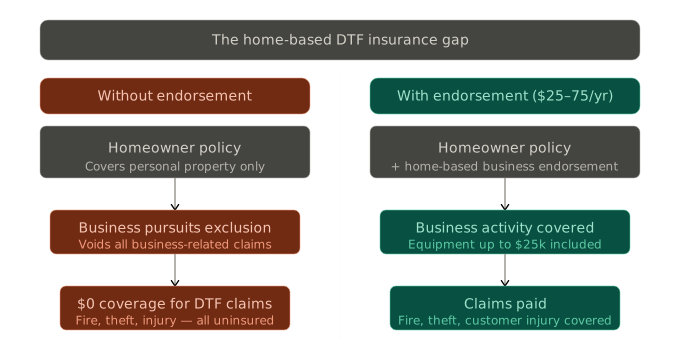
A DTF printer, curing oven, and heat press running simultaneously draw a combined electrical load that a standard residential circuit is not designed for. They generate heat. They run for hours. A basic homeowner’s or renter’s policy almost always contains a “business pursuits exclusion” — meaning if your curing oven causes a fire while fulfilling a customer order, your personal policy pays nothing. Not for the equipment. Not for the structural damage. Not for anything.
This is not a theoretical risk. House fires caused by commercial equipment operating in residential settings are one of the most common small business property claims in the US. The fix is simple and cheap. Most operators just do not know they need it until it is too late.
The Liability Side of Physical Products
When you produce a finished transfer and a customer presses it onto a garment, you are a manufacturer. If that transfer causes a skin reaction, damages a garment, or peels off and causes someone to trip, there is a chain of liability that can lead back to you. Customers do not always separate “the design failed” from “the shop that made it failed.” General liability insurance is what protects you when that conversation stops being friendly and becomes legal.
Intellectual Property: The Risk Nobody Talks About
Here is the scenario that almost no guide covers. A customer emails you a design file. You print it. The design contains a trademarked character — a sports team logo, a cartoon figure, a brand’s registered wordmark. The rights holder discovers the infringing products and files a claim. The customer provided the artwork. But you manufactured it. In a meaningful number of jurisdictions, that makes you a party to the infringement.
“The customer gave me the file” is a partial defense at best. It is not a complete one.
The 4 Coverage Types That Actually Matter for DTF Operators
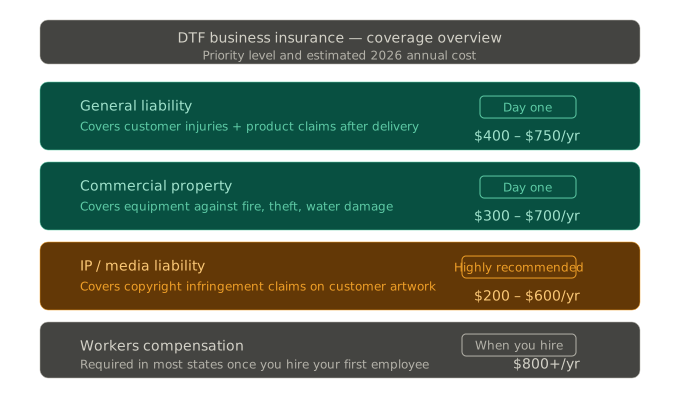
General Liability Insurance
General liability is the foundation. It covers third-party bodily injury and property damage claims arising from your business operations. If a customer visits your workspace and gets hurt, if a garment you produced damages a customer’s other clothing in the wash, or if a delivery driver slips on your driveway while picking up an order — general liability responds to all of these.
What to look for in a GL policy
Not all general liability policies are identical. Two terms worth understanding before you buy:
Products and completed operations coverage pays for claims that arise from your finished product after it leaves your hands. For a DTF operator who ships transfers to customers who press them at home, this matters. Some policies include it automatically. Others require you to add it as an endorsement.
Personal and advertising injury coverage protects against claims of copyright infringement, libel, or slander arising from your advertising. This is separate from IP liability on your actual products, but it covers you if a competitor claims your marketing materials copy their branding.
What it costs
For a home-based operator with under $100,000 in annual revenue and no employees, a $1 million per-occurrence general liability policy typically runs $400–$750 per year through carriers like Hiscox, Next Insurance, or State Farm. Quotes above $1,000 for a home-based solo operation are worth shopping around.
Commercial Property Insurance
Your equipment has real value. A mid-range DTF printer alone is worth $4,000–$6,000. Add a heat press, powder shaker, computer, software licenses, and two to four weeks of ink and film inventory, and you are looking at $8,000–$20,000 of business assets sitting in your workspace.
A homeowner’s policy typically caps business equipment coverage at $2,500. Many cap it at zero. Commercial property insurance covers your equipment against fire, theft, water damage, and other named perils at full replacement value.
Home-based vs. commercial space property coverage
For home-based operators, a home-based business endorsement (added to your existing homeowner’s or renter’s policy) is the most cost-efficient starting point. This endorsement costs $25–$75 per year at most carriers and extends business equipment coverage up to $10,000–$25,000 depending on the policy.
For operators in a commercial space, standalone commercial property coverage is required. Premiums typically run $300–$700 per year for a small shop with under $30,000 in equipment value.
Equipment breakdown coverage
Worth adding as an endorsement if your insurer offers it. Standard commercial property covers damage from external events — fire, theft, water. Equipment breakdown coverage kicks in when the equipment itself fails mechanically or electrically, which standard property policies explicitly exclude. For a printer that costs $5,000 to replace, this endorsement typically costs $100–$200 per year and pays for itself the first time a printhead burns out from an electrical surge.
Business Owner’s Policy (BOP)
A Business Owner’s Policy bundles general liability and commercial property into a single package at a lower combined premium than buying both separately. For most DTF operators generating under $500,000 annually, a BOP is the most cost-efficient structure.
Who should get a BOP vs. separate policies
If you are a home-based operator with a home-based endorsement already on your homeowner’s policy, adding a standalone general liability policy is often cheaper than a full BOP. Once your operation grows to the point where you need standalone commercial property coverage — typically when your equipment value exceeds what a homeowner’s endorsement covers — a BOP makes more financial sense.
BOP cost by operation size
Home-based, solo operator, under $100k revenue: $600–$1,100 per year.
Small commercial space, 1–2 employees, $100k–$300k revenue: $1,200–$2,500 per year.
Small shop, 3–5 employees, $300k–$500k revenue: $2,000–$4,000 per year.
These are market estimates for 2026. Your actual premium depends on your state, your claims history, your square footage, and how honestly you describe your operation to the carrier.
Intellectual Property Liability Coverage
This is the coverage most DTF operators skip. It is also the one with the most unpleasant surprises attached to it.
How IP liability works for print shops
Copyright infringement claims against print shops and garment decorators have increased significantly since 2018, driven by rights holders using automated image recognition tools to scan e-commerce platforms for unauthorized use of their IP. The minimum statutory damages for a single infringed work in the US is $750 under the Copyright Act — and that is for unintentional infringement. Willful infringement starts at $30,000 per work.
A shop that produces 50 custom shirts with an unauthorized Mickey Mouse design is not looking at one claim. It is potentially looking at $750 per shirt, per work, which adds up to numbers that can close a small business.
What IP coverage actually covers
A media liability or intellectual property endorsement covers your legal defense costs and any settlements arising from IP infringement claims — even when the infringement came from customer-supplied artwork. Some policies specifically extend to print-on-demand and contract manufacturing scenarios.
Coverage typically runs $200–$600 per year for a small print shop. Given that a single IP claim in federal court can generate $15,000–$50,000 in legal fees before any settlement, the premium math is straightforward.
Practical steps alongside insurance
Insurance covers the financial exposure. It does not prevent the claim. The most effective risk reduction steps for DTF operators are:
- Include a written clause in your order terms stating the customer warrants ownership of or rights to all submitted artwork
- Decline orders where the design is clearly a recognizable trademarked character without documentation of licensing
- Keep records of customer-submitted artwork for at least three years
These steps do not make you legally immune, but they document your good faith and shift a portion of liability back to the customer when claims arise.
The Home-Based Business Insurance Gap
Running a DTF operation from your home creates a specific insurance problem that most generic small business guides do not explain clearly enough.
What the “business pursuits exclusion” actually means
Most standard homeowner’s and renter’s policies contain language excluding coverage for “losses arising from business activities conducted on the premises.” This means:
- A fire caused by your curing oven is not covered
- A customer who visits and is injured is not covered
- Your printer stolen from your home workspace may not be covered at full value
- Liability for products you manufacture at home may be excluded
The exclusion is designed to prevent homeowners from operating commercial operations without commercial coverage. It is enforced. Insurers investigate the cause of claims and deny coverage when they find that the loss arose from business activity.
The fix: home-based business endorsement
A home-based business endorsement is an add-on to your existing homeowner’s or renter’s policy that specifically carves out coverage for business activities conducted at your home address. It typically provides:
- Business equipment coverage up to $10,000–$25,000
- General liability coverage for business-related injuries on the premises
- Product liability for goods manufactured at the home address
Cost: $25–$75 per year at most major carriers. It is one of the best-value insurance purchases a home-based DTF operator can make.
At some point — usually when annual revenue consistently exceeds $50,000 — a standalone BOP provides more appropriate coverage limits than an endorsement. For operators just starting out, the endorsement closes the most dangerous coverage gap at minimal cost.
For a full breakdown of the legal and operational setup steps for home-based DTF operations, see our how to start a DTF business from home guide.
Insurance Cost Summary
| Coverage Type | Who Needs It | Annual Cost |
| General liability ($1M / $2M) | Every DTF operator | $400 – $750 |
| Home-based endorsement | Home-based operators | $25 – $75 |
| Commercial property | Any operator with $5k+ equipment | $300 – $700 |
| Business Owner’s Policy (BOP) | Growing operations | $600 – $2,500 |
| IP / media liability | Operators printing customer artwork | $200 – $600 |
| Workers’ compensation | Operators with employees | $800 – $3,000+ |
Coverage You Can Skip for Now
Commercial auto insurance. Unless you operate a delivery vehicle for your business, your personal auto policy covers incidental business driving in most states. Worth confirming with your carrier, but rarely a day-one purchase for a home-based DTF operator.
Professional liability (errors and omissions). Relevant if you offer design services as a core part of your business. If you only produce transfers from customer-provided artwork, the exposure is lower.
Cyber liability. Important once you are storing customer payment data and order histories digitally at meaningful scale. Not a first-year priority for most solo operators.
Employment practices liability. Relevant only when you have employees. Skip until you hire.
How to Get Covered Quickly
The fastest path is through an online insurer that handles small business policies digitally. Next Insurance, Hiscox, and Thimble all quote and bind coverage in under 30 minutes without requiring an agent. Have your estimated annual revenue, your workspace square footage, and your equipment value ready before you start.
For operators who want agent support — particularly useful if your situation is non-standard, such as running DTF alongside another trade — a local independent agent who works with small business clients can compare policies across multiple carriers and often finds lower premiums than direct online quotes for more complex operations.
One practical note: do not describe your business inaccurately to get a lower premium. Insurers investigate claims. If your description does not match your actual operation at claim time, the policy may be voided. The premium difference between an accurate description and an inaccurate one is rarely worth the risk.
Frequently Asked Questions
Do I need insurance to start a DTF business from home?
Not legally — there is no law requiring you to have business insurance before operating. Practically, though, running commercial equipment in a residential space without coverage creates a real financial exposure. A homeowner’s business endorsement ($25–$75/year) closes the most immediate gap and is worth buying before you take your first paid order.
Does my homeowner’s insurance cover my DTF printer?
Most standard homeowner’s policies do not cover business equipment at full value, and many exclude it entirely under the business pursuits exclusion. A home-based business endorsement adds business equipment coverage to your existing policy at low cost. For equipment worth over $25,000, a standalone commercial property policy provides more appropriate limits.
What happens if a customer gives me a design that violates copyright?
In most cases, the customer bears primary liability. However, as the manufacturer of the infringing product, you may also be named in a copyright infringement claim. IP liability coverage (a media liability endorsement or standalone policy) covers your legal defense costs and any settlement in this scenario. Including a warranty of rights clause in your order terms also helps shift liability back to the customer.
How much does DTF business insurance cost per month?
A basic home-based coverage package — general liability plus a home-based endorsement — runs approximately $35–$70 per month. A full Business Owner’s Policy for a home-based operator runs $50–$90 per month. Adding IP liability brings the total to roughly $65–$115 per month for comprehensive coverage.
Do I need workers’ compensation if I work alone?
No. Workers’ compensation is required only when you have employees, and requirements are state-specific. Sole proprietors working alone are generally exempt. Once you hire your first person — including part-time workers in most states — workers’ comp becomes mandatory. See your state’s department of labor website for specific requirements.
Conclusion
Most DTF operators spend months researching printers and zero hours researching insurance. That imbalance makes sense early on — equipment decisions feel urgent and insurance feels abstract. But the financial exposure from a single uninsured event routinely exceeds a full year of premiums.
The good news is that getting covered is not complicated. A home-based endorsement and a general liability policy are both available online in under an hour. For most solo operators, the total annual cost is under $800.
At imakedtf.com, we help DTF operators build businesses that are set up to last — from equipment decisions to marketing systems to operational foundations like insurance. Get in touch →
DTF business insurance is not the most exciting part of building a print operation — but it is the part that determines whether a bad day stays a bad day or becomes a business-ending event.
Last Updated: April 2026 | Related: How to Start a DTF Business from Home | DTF Startup Costs | DTF Printing Business Guide